
What makes strawberry plants run
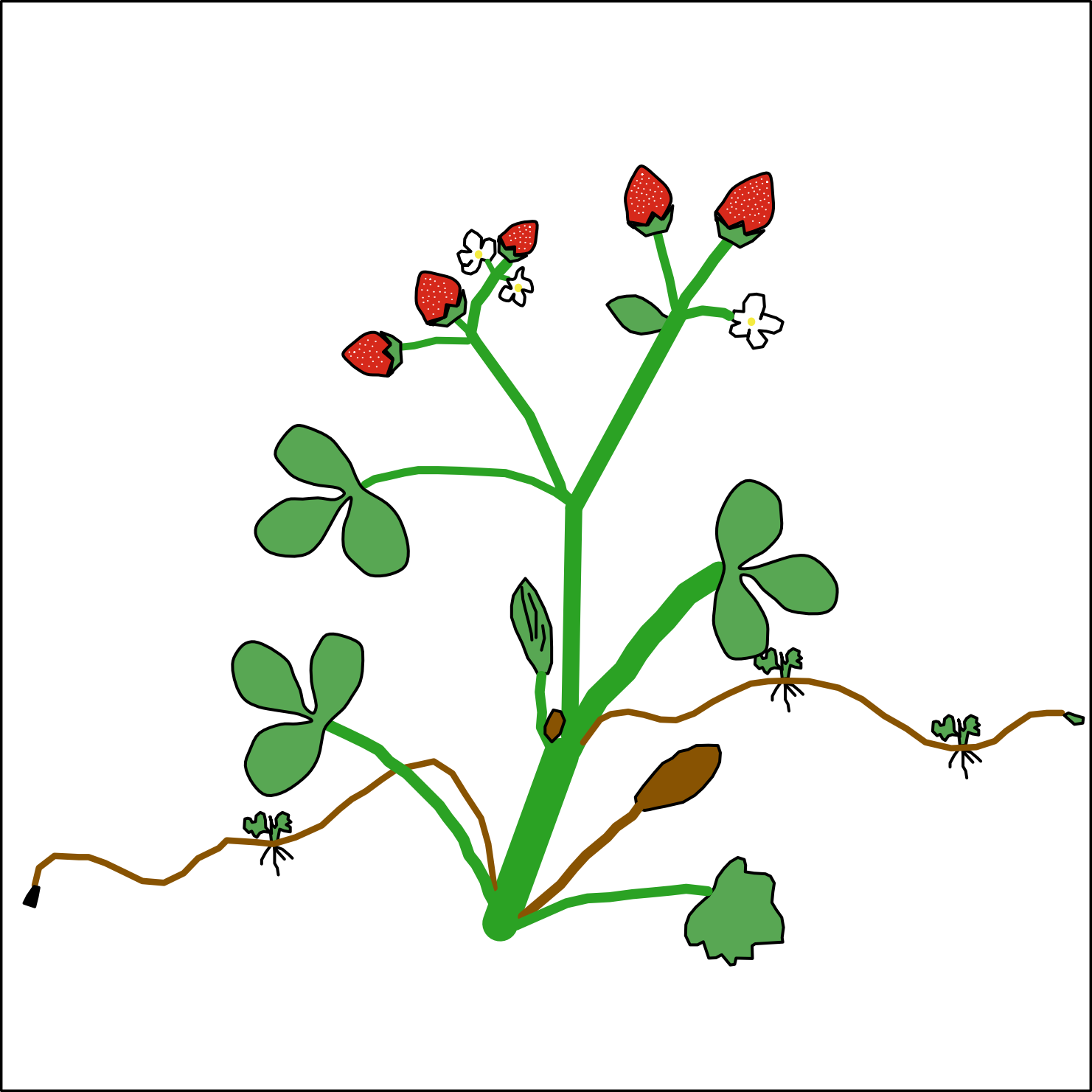
If you ever grew strawberry plants then you know they are prone to produce runners, which produce daughter plants along their stems, but no strawberries. This is not only a nuisance for the hobby gardener, but also for farmers. Now a group of Chinese and American researchers found out how plants regulate the formation of those runners.
Runners develop from so called auxiliary meristems, meristems that are formed in the hooks and crannies of the stem and from which branches originate. Those branches can adopt different identities. There is the run of the mill branch that we all recognise as a branch. In strawberry plants those regular branches are replaced by two other types of branches. The branch crowns on which flowers and eventually the strawberries form. And the runners. Now a strawberry plant can choose what type of branch the auxiliary meristem develops. It is known that high temperature and long days results in runners, while low temperatures and short days gives strawberry producing crown branches. But scientist want to know what else might influence the plants decision, so they set out to find out.
Running only as an adult
The first thing that the researchers did was checking how their wild-type strawberry plants behave. While doing this they realised that that the auxiliary meristems formed when the plant was still a juvenile, developed as branch crowns, while the auxiliary meristems that developed when the plant had reached its adult stage, developed into runners. This gave them a reliable phenotype which they could interrogate with mutant studies.
The first mutant to be analysed was that for the production of gibberellin. When the plant could not produce gibberellin the auxiliary meristems of mature plants developed into branch crowns, even when the auxiliary meristems were formed when the plant reached its adult stage. Indicating that gibberellin steers these meristems towards the development of runners.
A second mutant that the researchers tested was for the red and far-red light receptor PhyB. Sowing that when this receptor doesn’t work the auxiliary meristems from the juvenile stage of the plant don’t mature. Indicating that the perception of red light is needed for the auxiliary meristems to mature.
Four developmental stages
Now having all those mutants, and clear developmental stages the researchers wanted to find out what regulates the gibberellin production that is needed for the switch from branch crowns to runners. By comparing the genes that were active during those different stages the researchers found a group of four transcription factors, which regulate gene transcription. One of these, ZFP6, the researchers further investigated.
Like the gibberellin mutant, plants that do not have a functional ZFP6 gene also don’t produce runners. Moreover, they don’t activate the production of gibberellin, indicating that ZFP6 likely regulates this.
While previously it was suggested that there are only two stages of auxiliary meristem development, initiation and outgrowth, this study adds two more stages. After the initiation stage the researchers say there is a maturation stage. This is the stage in which red-light perception plays a role. This stage is followed by a fate determination stage, which in strawberry is influenced by the level of gibberellin. The researchers renamed the outgrow stage into differentiation stage, which is governed by local cytokinin levels.
Literature
Guo L., Li M., Luo X., He T., Ma N., Tang S., and Liu Z. (2026). Integrative regulation of axillary meristem maturation and stolon fate determination in strawberry by light, gibberellin, and ZFP6. Mol. Plant. 19, 191–207. https://doi.org/10.1016/j.molp.2025.12.001
 Plant en Zo