
By stress hit pause
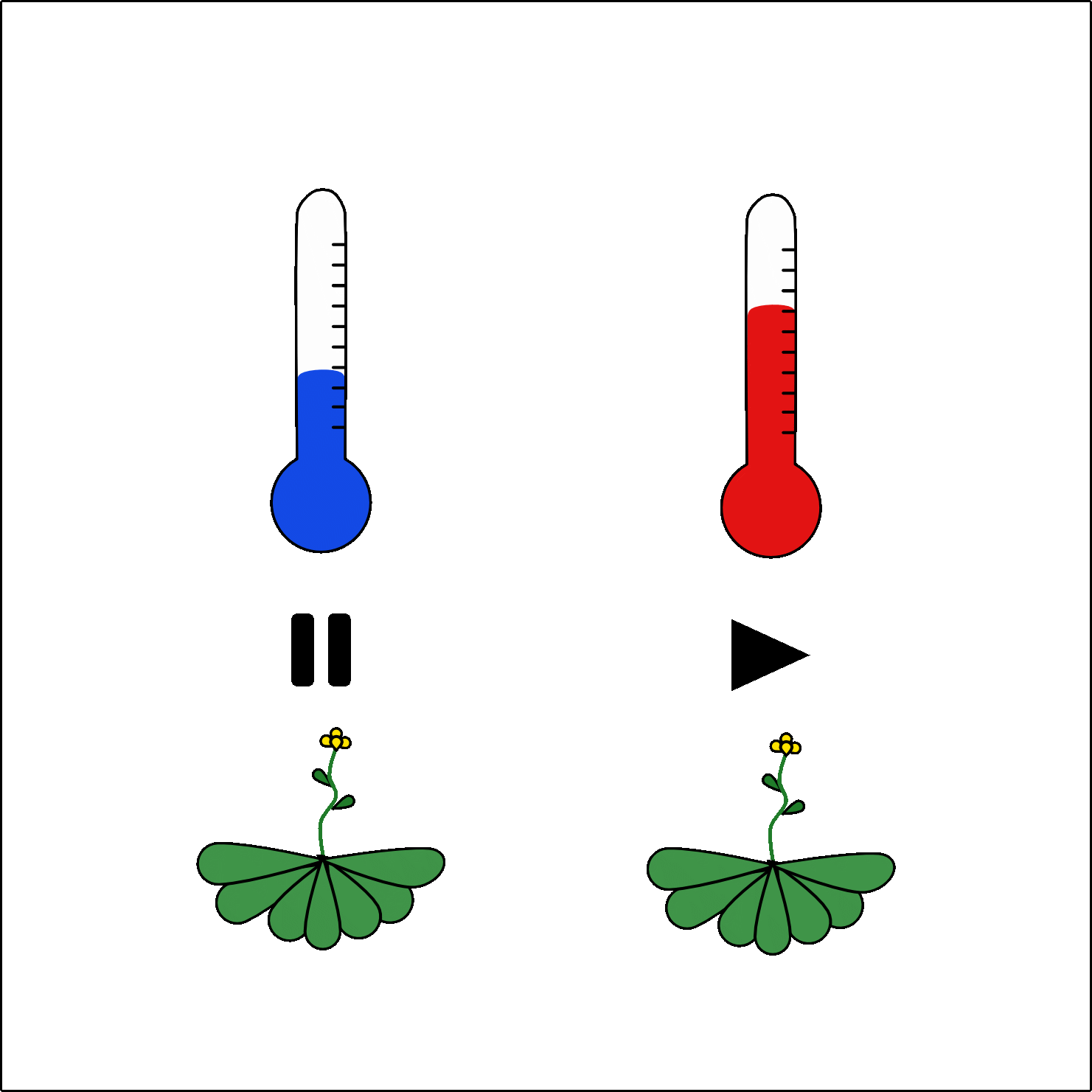
Stresses, like cold and salt stress, impact plant growth. Not only during the stress but also during the recovery. Now Canadian researchers discovered how during stress plants pause their cell division, which they continue after the stress is gone.
Plant growth basically consists of dividing and elongating cells. The researchers wanted to know which of these two processes caused the growth effect seen in stressed plants. After exposing Arabidopsis, brachypodium, and annual ryegrass to cold and salt stress the researchers observed reduced root growth. From which the plants recovered after being placed in a non-stress environment.
As the researchers were interested in finding out if cell division was affected during cold and salt stress, they used a cell cycle marker to follow cell divisions during cold or salt exposure and their recovery afterwards. This enabled the researchers to see that during stress exposure there was less cell division. But that during recovery both cell division and elongation started again.
Cell division on hold
Now is cell division a process that takes place in different phases, a preparation, or gap phase, an S phase in which the genome is duplicated, another gap phase, and an M phase in which the cell splits in two daughter cells. There are two kinds of actions cells can take when exposed to stress. The first is to pause the cell division, and the second is to finish an ongoing cell division and wait then with subsequence cell divisions till the stress has passed. The researchers noticed that during stress the plant cells go for the first option, they paused their division in one of the gap phases. Waiting out the stress there.
Subsequent the researchers wanted to know which cell division genes were regulating this pause during the stress. To find out they chemically blocked the cell division. The chemical that best copied the observed pause effect blocked the function of the cell cycle enzyme CDKA;1. Was this chemical present during the recovery after stress exposure, then the cells did not resume their division.
Identification of the regulators
Subsequently the researchers studied the enzymatic inhibitor of CDKA;1, ICK1. Plants that made more ICK1 proteins recovered less from cold and salt stress than plants with normal amounts of ICK1. Indicating that CDKA;1 and ICK1 are involved in this pause and restart during and after cold and salt stress.
So, plant cells use a sort of pause and play concept for their cell divisions during stress and the subsequent recovery. This allows them to quickly continue with their growth after the stress passed. Knowing which genes are involved gives scientists an opening to try to make this recovery take place even faster.
Literature
Hazelwood, O.S., Diehl, K.A., Hollenbeck, V., Demura-Devore, J., Herb, D., Gallagher, J.P. and Ashraf, M.A. (2026), Cell cycle follows ‘pause and play’ mechanism in salt and cold stress recovery in diverse plant species. New Phytol. https://doi.org/10.1111/nph.71041
 Plant en Zo