
Seed banks shape gene drive outcomes
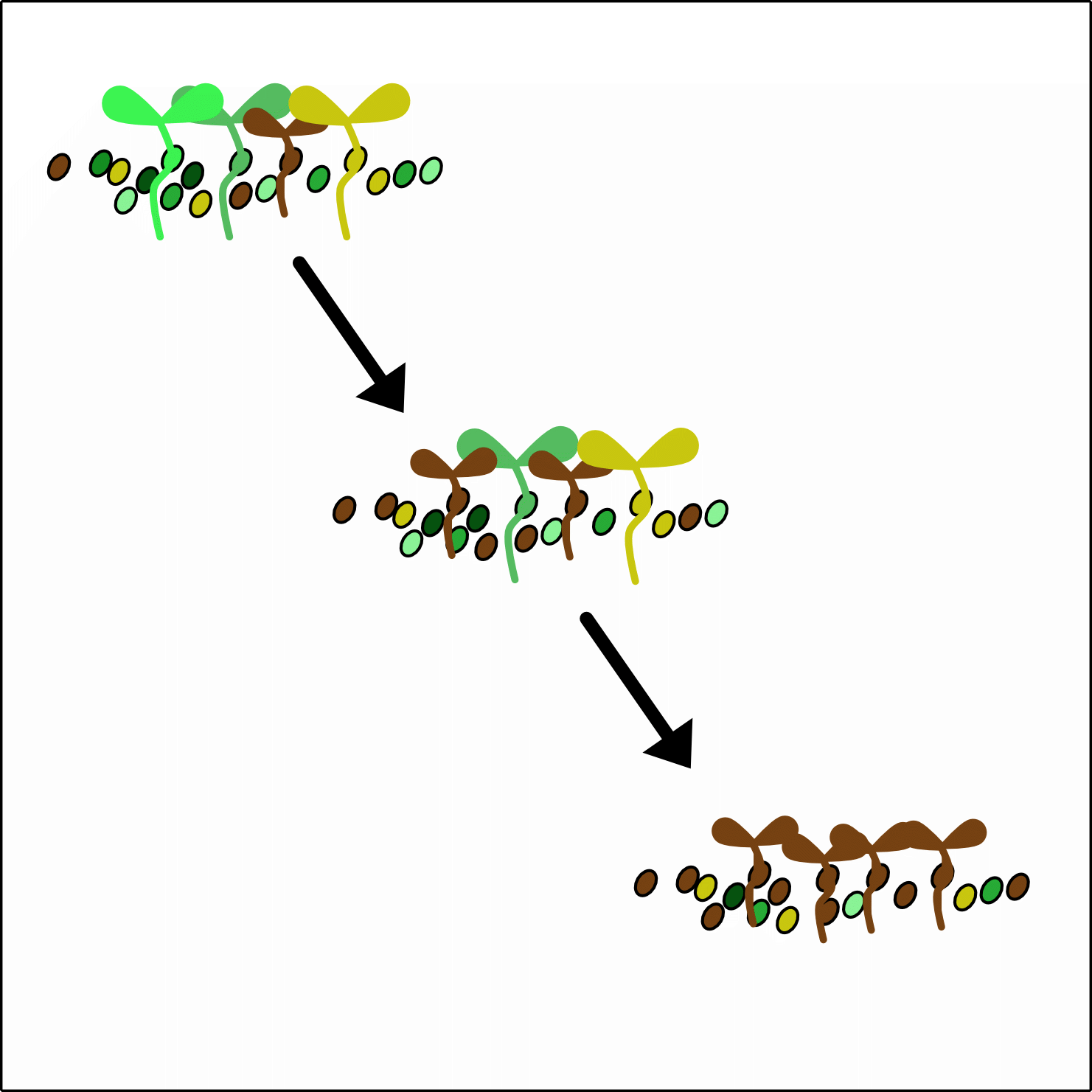
Seeds have this amazing ability to lay dormant in the soil for many years. As such, although genes are transferred from one generation to the next, that next generation isn’t always directly following the previous one. This makes studying the outcome of plant reproduction more complex. Now a new paper in Nature Plants shows how seed dormancy influences the success of gene drives.
Seeds from different years that lay dormant in the soil, waiting till it is a good time to germinate, form a so-called seed bank. This intergenerational seed bank is a mix of new and old genotypes. As such a plant with a genotype and a trait that was last seen years ago could appear apparently from nowhere.
This is one of the challenges farmers deal with when combatting weeds. These unwanted plants in a farmer’s field that take up precious nutrients and are competing for space and access to sunlight, which ultimately results in a yield loss. Frustratingly these weeds keep popping up year after year even with proper management.
A gene drive for plants
Long standing use of herbicides to combat these weeds resulted in herbicide resistance. So, farmers need an alternative way to deal with weeds. And although mechanical weeding is a good alternative. Having less weeds to start with is even better.
Enter the gene drive. This is a genetic system that skews the inheritance of specific traits, so that they have a greater chance to be inherited. One area in which the use of a gene drive is discussed widely is to limit the reproduction of mosquitos, so that there is less chance of mosquito transferred diseases in that neighbourhood.
Until recently talk about gene drives in plants was strictly theoretical. It could in theory limit the reproductive success of weeds, so that ultimately their population collapses. Recently two studies created genes drives in plants, CAIN, and ClvR. Both of which in laboratory settings showed that these genes, which when inherited resulted in non-viable pollen, or non-viable pollen and ovules, and can spread quickly through the population and ultimately causes them to collapse.
Interaction between gene drive and seed bank
But that was in laboratory settings. Whereby each successive population existed solely out of the offspring of the previous population. That is, however, not how it works in the real world. There seeds lay dormant in the soils seed bank. There a population is a mix of the offspring of the previous ten, twenty, or more populations. So, the researchers of this new study tried to predict what happens in the field.
For their predictions the researchers considered different situations. The first one was replacing an unwanted version of a gene by a preferred version of that gene so that the population changes but is not necessarily reduced. This is like swapping the gene for a white flower for one that result in a purple flower. In this situation having a system that works via both the male as well as the female line, like that of ClvR, results faster in a population change. But the speed with which the population change occurs depends on the percentage of the population that contained the gene drive at the start, and how long the seeds could stay dormant.
This also counts for the second situation that was tested, whereby the goal was population collapse. Here the outcome is even less straightforward. A strong gene drive, like the male sterility version of ClvR resulted in a collapse of the population in all different starting points tested. But weaker gene drives like that of CAIN only worked if the seeds did not stay dormant for too long or the plants did not produce to many seeds. As more viable seeds without the gene drive present could survive for a long time in the soil and eventually out compete the seeds with the gene drive.
Saver to use
This shows that a gene drive can only survive in a population if its fitness costs are not too high. So far, the researchers worked with the assumption of a single initial release or introduction of the gene drive containing plants. However, by changing the size of the introduced gene drive containing population, or even multiple introductions, the survival changes of the gene drive in the population can increase. Giving it a chance to do its job.
So, seed banks can make it more difficult for a gene drive population to take hold. This same feature however slows down the expansion of the gene drive population outside its target area. This would, at least in theory, make the use of gene drives in plants saver than say in insects.
And that brings us to one of the weaker points of the paper. This is all theory. The researchers modelled the different variations tested. Assuming the conditions tested and leaving out real world things that complicates the model. Like for example, that some weeds like to hug particular areas of a field, premature dead of plants due herbivores, or other environmental factors that might speed up or slow down the development of the plant which in turn has an effect on its seed production. This all would also influence the effect of the gene drive success.
So, is a gene drive system a good way to eliminate weeds in a field? Maybe, but it would take some time, at least a good chuck of a farmers working live if not more. And only in combination with other tactics of eliminating weeds.
Literature
Kim, I.K., Tian, L., Chaffee, R. et al. Seed dormancy shapes gene drive dynamics in plants. Nat. Plants (2026). https://doi.org/10.1038/s41477-026-02256-1
 Plant en Zo