
How plants photosynthesize
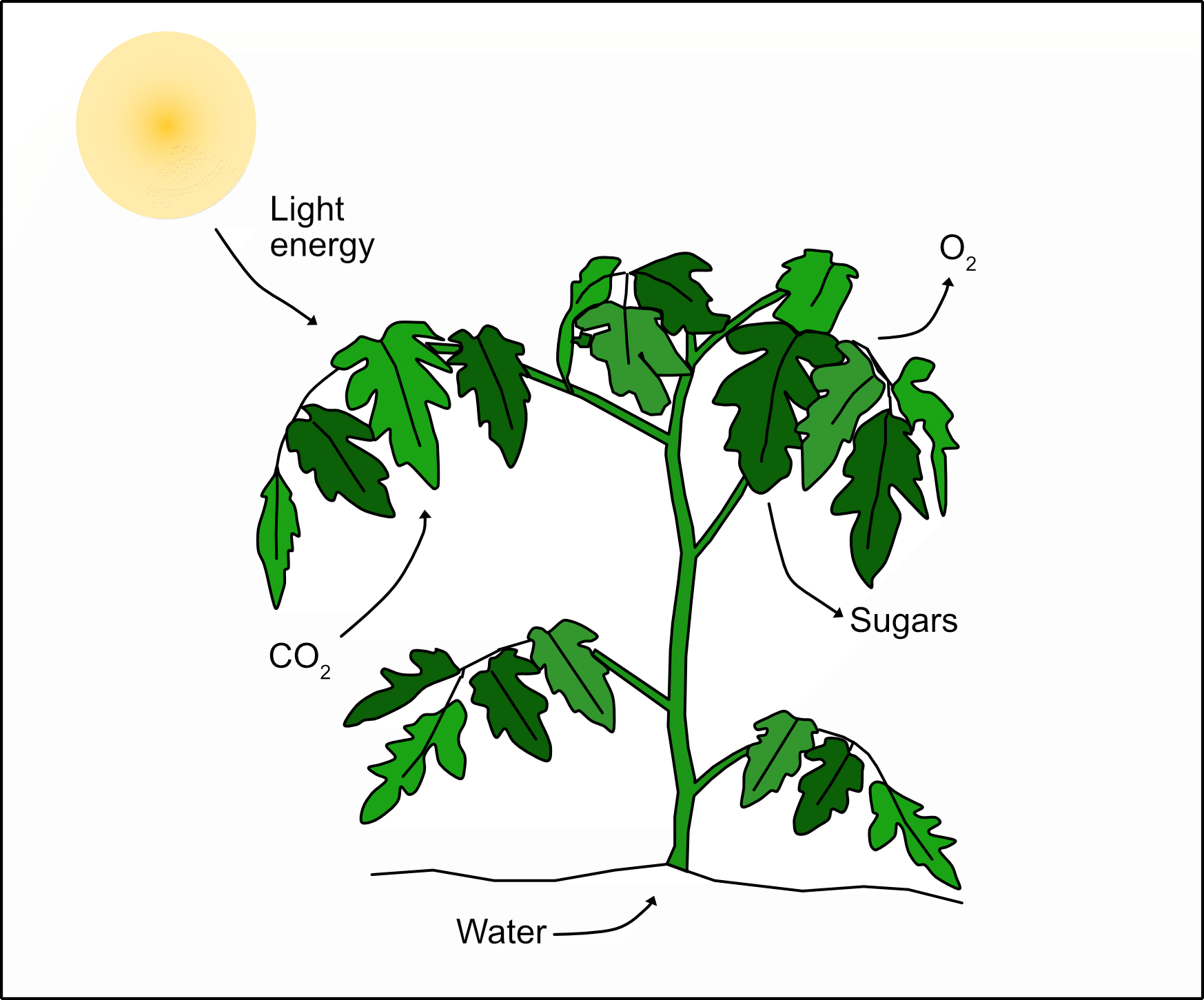
Sometimes it seems that plants grow spontaneously. Yes, they might need some water so now and then, but that is about it. This all is due to maybe one of the coolest tricks of plants in that they produce their own food. They more or less wipe it up out of thin air. Using water, carbon dioxide, and minerals as staring materials and some energy of the sun, they are able to produce all the molecules they need for growing and thriving. Photosynthesis plays a major role in this process.
But before I dive into how plants photosynthesize, lets take a step back and look why that food is needed. We, animals, plants and all other living organisms require food to give us the energy and building blocks we need to stay alive and grow. Most of that energy is coming from carbohydrates, varying from simple to complex sugars. These function as a kind of battery to store energy and deliver carbon atoms for building more complex molecules, like those of cell walls or proteins. It are these simple sugars that get produced during photosynthesis.
So, lets dive in.
Photosynthesis is a complex process. It involves over 50 reaction steps. But at the same time, it is also elegantly simple. You can bring it back to the equation:

A process that you can compare to obtaining and storying renewable energy. In the case or renewable energy, raw wind or solar energy is transferred into electrons, a.k.a. electricity. Given the choice those electrons give off their energy to the first thing they come across. While this might be a good thing when there is a high energy demand. If, however, the demand is not there when the energy is produced, then the produced energy gets wasted if you don’t store it in a battery.
Scientists discovered that the same counts for plants and their energy capture during photosynthesis. Plants first transfer light energy to temporary energy carriers called ATP (Adenosine triphosphate) and NADPH (Nicotinamide adenine dinucleotide phosphate). These are great for functioning as a go between, delivering an energy from one molecule to another.
However, ATP and NADPH aren’t good at keeping hold of that energy when traveling over long distances, say going from the leaves to the roots. Therefore, plants use this harnessed energy to fix carbon into sugars. Plants do this via the Calvin cycle. These sugars can then easily travel through the plant to where energy and building material is needed, or stored for later use.
Harnessing light
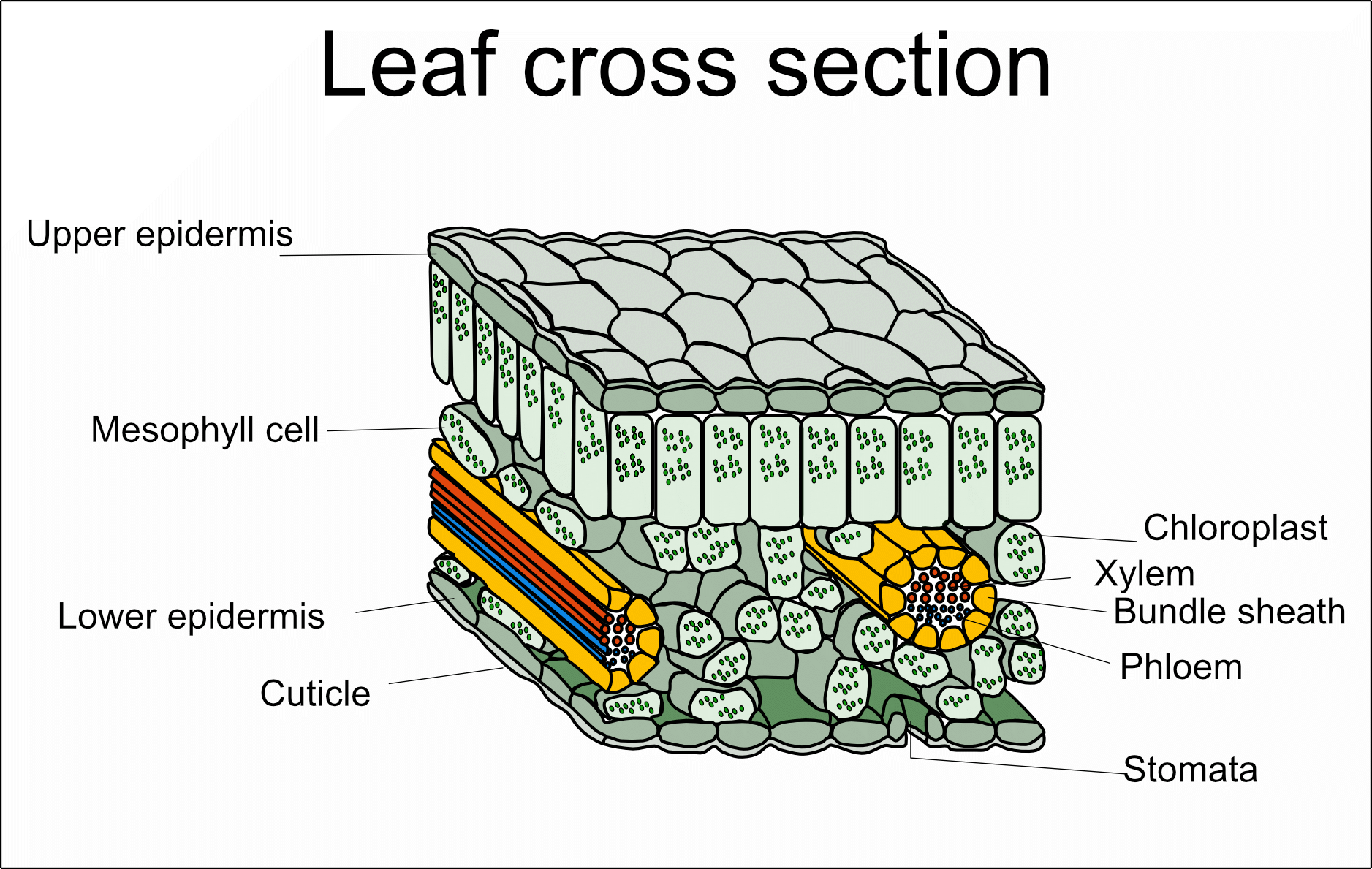
Photosynthesis takes place in the leaves. Between the top and bottom layer of the leaf cells are loosely distributed with lots of airy space. These are mesophyll cells, and those airy spaces helps them with taking up CO2. Mesophyll cells have specialized compartments called chloroplasts. And inside these compartments there are stacks of interconnected membrane disks called thylakoids which are surrounded by a space called the stroma. It is here where all the action takes place. The thylakoid membranes capture the energy from the sun and deliver the temporary energy carriers into the stroma, where they are snatched up by enzymes creating the sugar molecules.
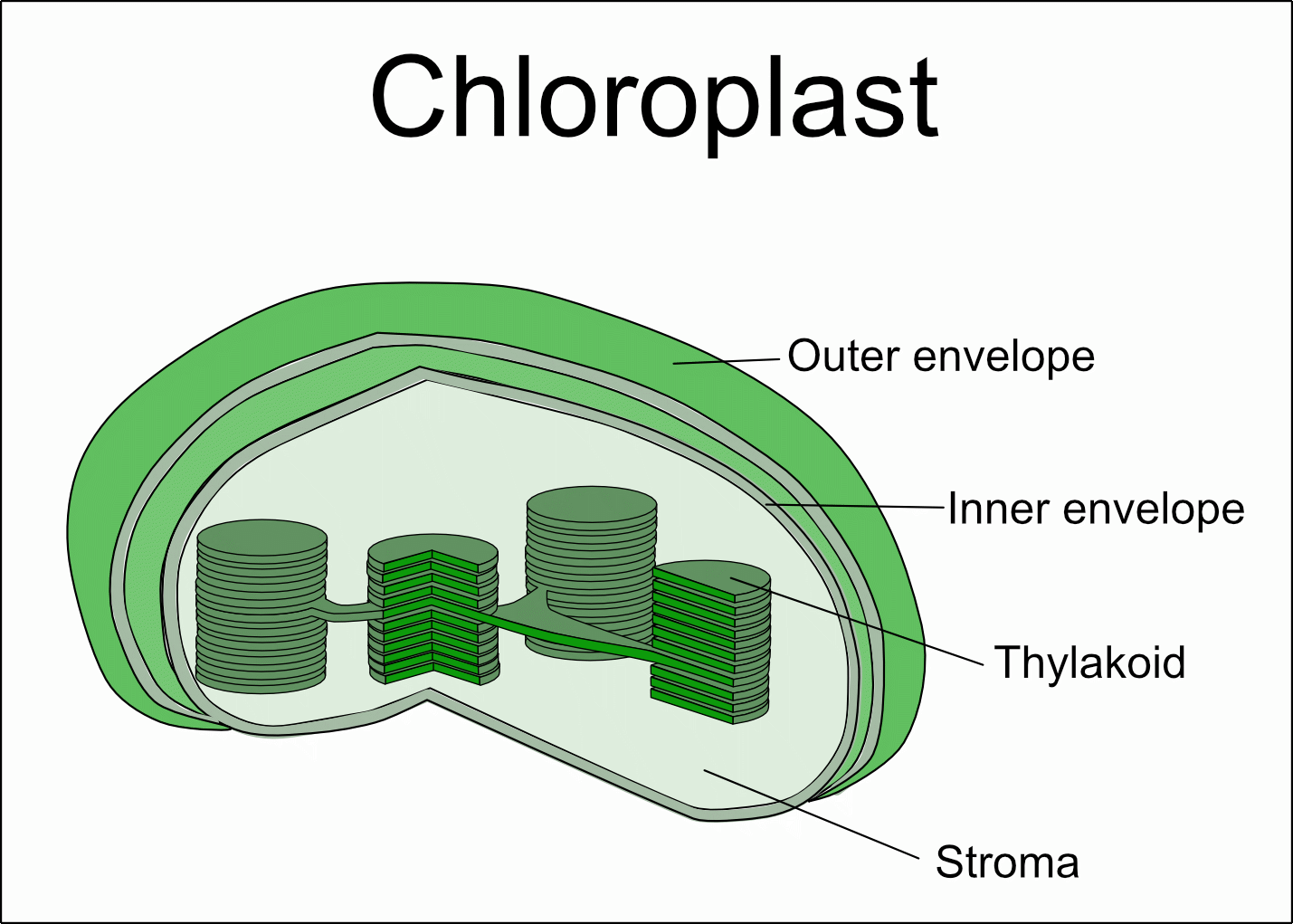
Plants can capture light energy because light consists of photon particles which carry with them a little bit of energy. How much energy, that depends on the wavelength they travel with. Chloroplasts are packed with molecules who absorb photons. Chlorophyll for absorbing the blue and red light and carotenoids for absorbing blue/purple light. The only sunlight that isn’t absorbed is green, that is reflected, explaining why plants are green.
Carotenoids can also absorb excess of energy and release this as heat. In this way carotenoids protect the photosynthesis machinery from damage that can occur from too much energy.
Upon absorbing a photon, a chlorophyll or carotenoid molecule has four options. It can 1) send the photon away, causing fluorescence, it can 2) release the energy from the photon in the form of heat, the same process that warms you up when standing in the sun, it can 3) give the energy from the photon to another molecule, or it can 4) use the energy from the photon to make a chemical modification. It are the last two processes that the plant use for storing the photon’s energy in a temporary carrier.
They do this as follow: The thylakoid membranes contain protein/pigment complexes that together form a light energy transferring antenna complex and an electron transfer reaction centre. First, the antenna complex, this consists of many chlorophyll and carotenoid molecules. Together they are collecting the light energy, which they transfer to the reaction centre. Upon receiving the light energy a chemical reaction takes place in the reaction centre which starts an electron transfer estafette. This ends with giving a hydrogen atom (H+) to an NADP+ molecule, charging it so to speak. This newly formed NADPH molecule is formed in the stroma side of the thylakoid membrane.
To get most energy out of the sun plants contain two types of photosynthesis reaction centres, those of photosystem II and photosystem I. Although they each can capture light energy, they work best sequentially, with photosystem II passing its electrons on to photosystem I who ultimately transfers it to the NADP+ molecule.
During this process of energy transfer among the different reaction centres hydrogen atoms are also released on the thylakoid side of the membrane. Plants use these hydrogen atoms to charge the second temporally energy carrier, ATP.
Storing the energy in a battery
Now the plant has charged those temporary energy carriers the plant needs to use them or lose them. Opting for the first option, plants use the obtained energy to lock in one of the required materials for growth CO2, or to be precise carbon. Cells can best use carbon in the form of a simple sugar.
Plants obtain CO2 from the air via stomata, small pores in the underside of the leaf. The only problem is that water vapour leaves the plant via those same pores.
Maybe surprisingly plants do this not by directly binding six CO2 molecules with six water molecules. It is for enzymes easier to attach a small molecule like CO2 to a larger molecule. So that is what plants do in a process called the Calvin cycle. Much of this cycle has to do with recycling the larger molecule, and it is for this a lot of captured energy is used. But I like to focus on the step that attaches CO2 to that larger molecule.
This step is done by an enzyme called ribulose bisphosphate carboxylase/oxygenase, rubisco for short. Like its name suggests it uses the molecule ribulose-1,5-bisphosphate as a starting molecule to fix CO2 and water. This process produces two molecules 3-phosphateglycerate. Of every six molecules 3-phosphateglycerate produced, five need to be recycled to keep the Calvin cycle going, and one can be used for the production of sucrose, for more or less direct use, or starch for storage.
Did you know that rubisco is also the most abundant protein on the planet?
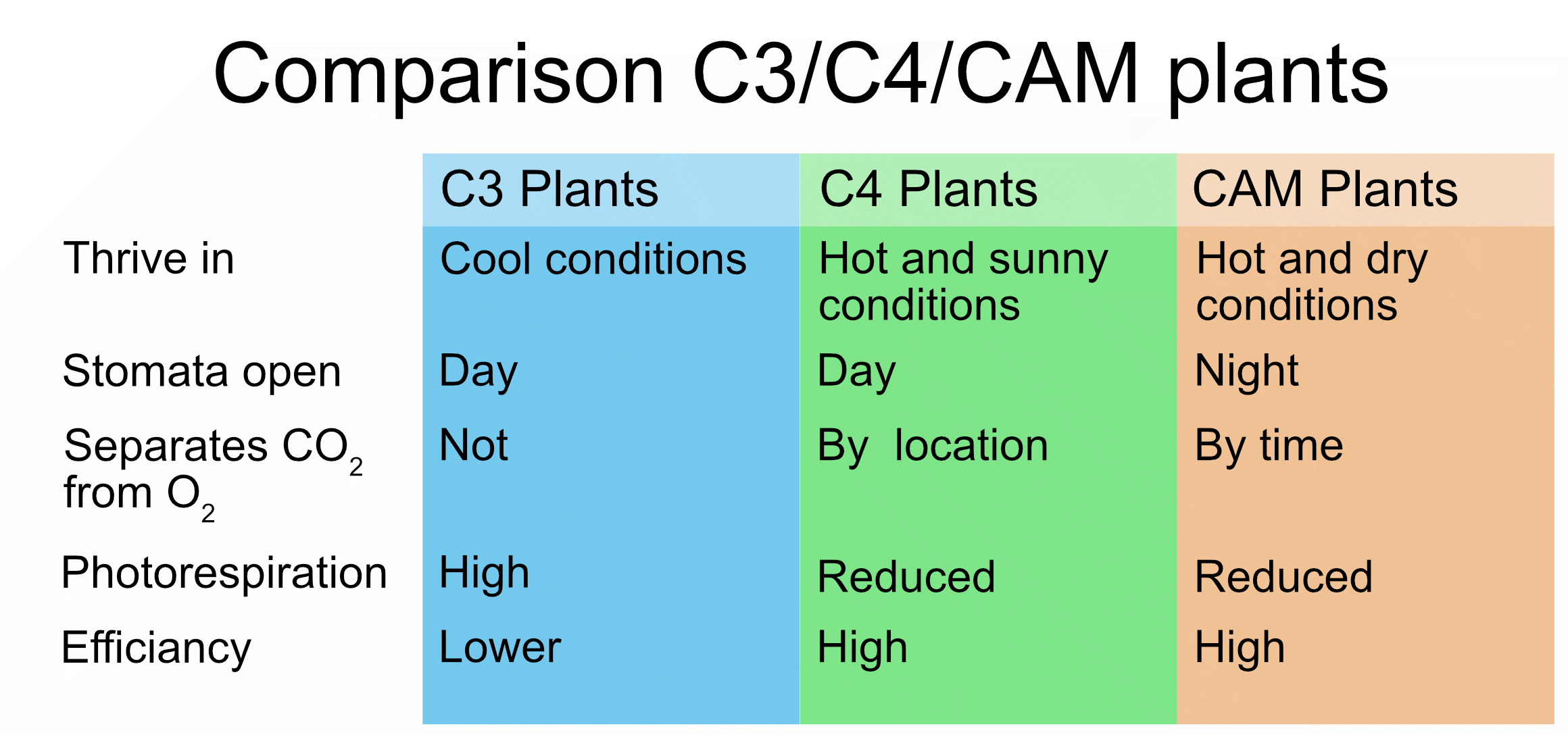
Now the reaction the process that I have described is for the photosynthesis of so-called C3 plants. While this process works nice on paper, rubisco has one drawback. Like its name already suggests, it can also use O2 instead of CO2. And it does this more often than occasionally. When rubisco uses O2 instead of CO2, carbon atoms get lost. To keep this loss to a minimum, plants recover most of those carbon atoms via a process called photorespiration.
Concentrating CO2
However, not all plants photorespire, or only do so for a limited amount. There are thee tricks that plants can use to overcome the need for photorespiration. They are basically different solutions for the same problem, keeping O2 away from rubisco. The first is the option aquatic plants go for. With CO2 dissolved in the water, they use CO2-pumps in their plasma membrane to take up CO2 but not O2. Preventing O2 from even getting inside the cell.
Then there is the second option where so-called C4 plants have gone for. They separate the location where CO2 is taken up from that where the Calvin cycle takes place. They do this by using two types of chloroplast containing cells. Whereas in C3 plants only the mesophyll cells contain chloroplasts, C4 plants contain chlorophyll containing bundle sheath cells as well.
The bundle sheath cells are physically connected to one or more mesophyll cells. In the mesophyll chloroplasts of C4 plants a kind of pre-fixing of CO2 takes place. This pre-fixed molecule then travels into the bundle sheath cells, were it CO2 is released and used in the Calvin cycle. The advantage of this system is that the enzyme for this pre-fixing has a high affinity for CO2 and ignores O2. And that it physically separates the place of CO2 capture and CO2 use.
The third option for concentrating CO2 is the one so called CAM plants went for. These plants have found a way to store the pre-fixed CO2. This trick gives them the flexibility pre-fix CO2 at night and use it for photosynthesis during the day. This enables CAM plants to close their stomata and prevent water loss during hot dry days. This separates CO2 capture from CO2 use by doing those processes at a different time of day.
So, photosynthesis is the process during which plants fix both energy and carbon into sugar molecules. These sugars the plant can then use to produce cellular building blocks, defence or scent molecules, or store, in the form of starch, for a rainy day.
Now photosynthesis as describes here seems like a straightforward process, you put some light energy together with CO2 and water in at one end and receive sugar molecules at the other end. But that is under optimal conditions. Plants constantly adapt their photosynthesis to the changing conditions they grow in. Like slowing down when there is less light, like on a cloudy day or in the shade. Or temporarily shut it down during the middle of a verry hot day to prevent water loss. And like people, photosynthesis also requires some time to get going at the beginning of the day. Plant scientists are still discovering how plants regulate this all, and if they can optimise those responses.


One thought on “How plants photosynthesize”