
A wild inheritance
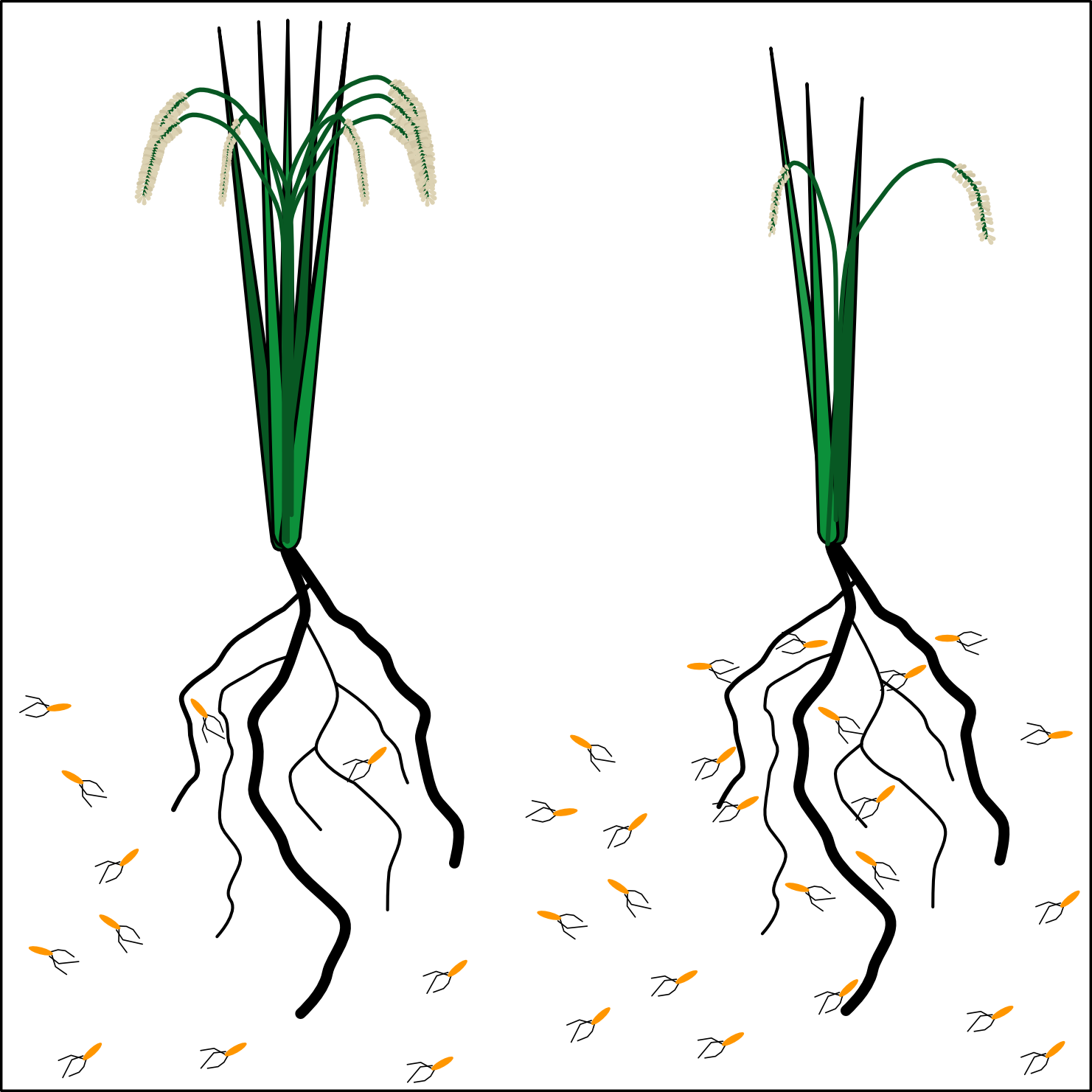
Beneficial microbes can help the plant with the uptake of the available nutrients. But modern crops where mostly bred to optimise above ground traits, completely overlooking, and potentially ignorant, of the below ground interactions with microbes. When using fertiliser and pesticides this neglect of below ground interactions was compensated. But now, when farmers like to reduce their use of fertilisers and pesticides the question raises how to stimulate those beneficial plant-microbial interactions.
Most of the nutrients in the soil are locked in a form plants can’t use. But microbes can. They process the available nutrients into a form that plants can take up and use. However, for the plant to benefit from this the microbes need to be close by for the plant. And most crops have lost the ability to cultivate their microbial helpers. Now a new study asked if for rice is possible to regain this ability from their wild relatives.
First thing they did was crossing wild rice with domesticated rice. Then the researchers grew the offspring and parents in rice paddies and analysed if the offspring had inherited the ability to attract the some of the same microbiome as its wild parent did. Finding the offspring did indeed. They also could find some regions in the rice genome that appeared to be correlated with this inherited ability.
Attracting a core microbiome
Then researchers repeated the field experiment with 265 domesticated rice varieties and 117 wild rice varieties. Again, finding regions in the rice genome that appeared to be correlated with the ability to attract beneficial microbes.
These field studies showed that with the same microbes available the wild rice plants attracted a core microbiome that helped them to use the available nutrients more efficiently, while the domesticated rice did not, or to a lesser extent. Showing that it was not the availability of the microbes, but the ability to see and use them that was preventing the domesticated rice plants of using those available microbes.
Next up the researchers zoomed in on one of the genetic regions that was correlated with attracting beneficial microbes. A receptor-like kinase gene, called OsRLK that appeared to be correlated with the attraction of Acinetobacter, a bacterium that in turn is correlated with better nitrogen use by the plant.
Getting a bit wild
To check if wild rice OsRLK can indeed attract Acinetobacter and obtain more nitrogen the researchers created plants that produced more of the wild rice OsRLK. Wild rice and domesticated rice with wild rice OsRLK had higher nitrogen levels that domesticated rice without wild rice OsRLK when grown with Acinetobacter. Grown without Acinetobacter there was no difference. Suggesting that wild rice OsRLK was indeed contributing to attracting Acinetobacter, and better nitrogen use efficiency.
Lastly the researchers checked the variations found in the gene sequence of OsRLK. Finding that, although there was lots of differences between the wild rice OsRLK and those found in domesticated rice, there where only three versions of OsRLK of which one contributed to better nitrogen use efficiency.
So just restoring the soil microbiome isn’t enough to restore the beneficial interactions between crops and microbes. This study showed that crops that are so to say blind and ignorant of how to use the available microbe populations won’t do better. The study also showed that the ability for crops to use the available beneficial microbes can be inherited from their wild relatives. Giving a way in for breeders to relearn crops how to see and use beneficial microbes.
Literature
Chang, J., Wang, D., Yao, Z. et al. Wild rice locus enables microbiome re-domestication for enhanced nitrogen-use efficiency. Nat Microbiol (2026). https://doi.org/10.1038/s41564-026-02498-x

