
Like liquid behaving proteins
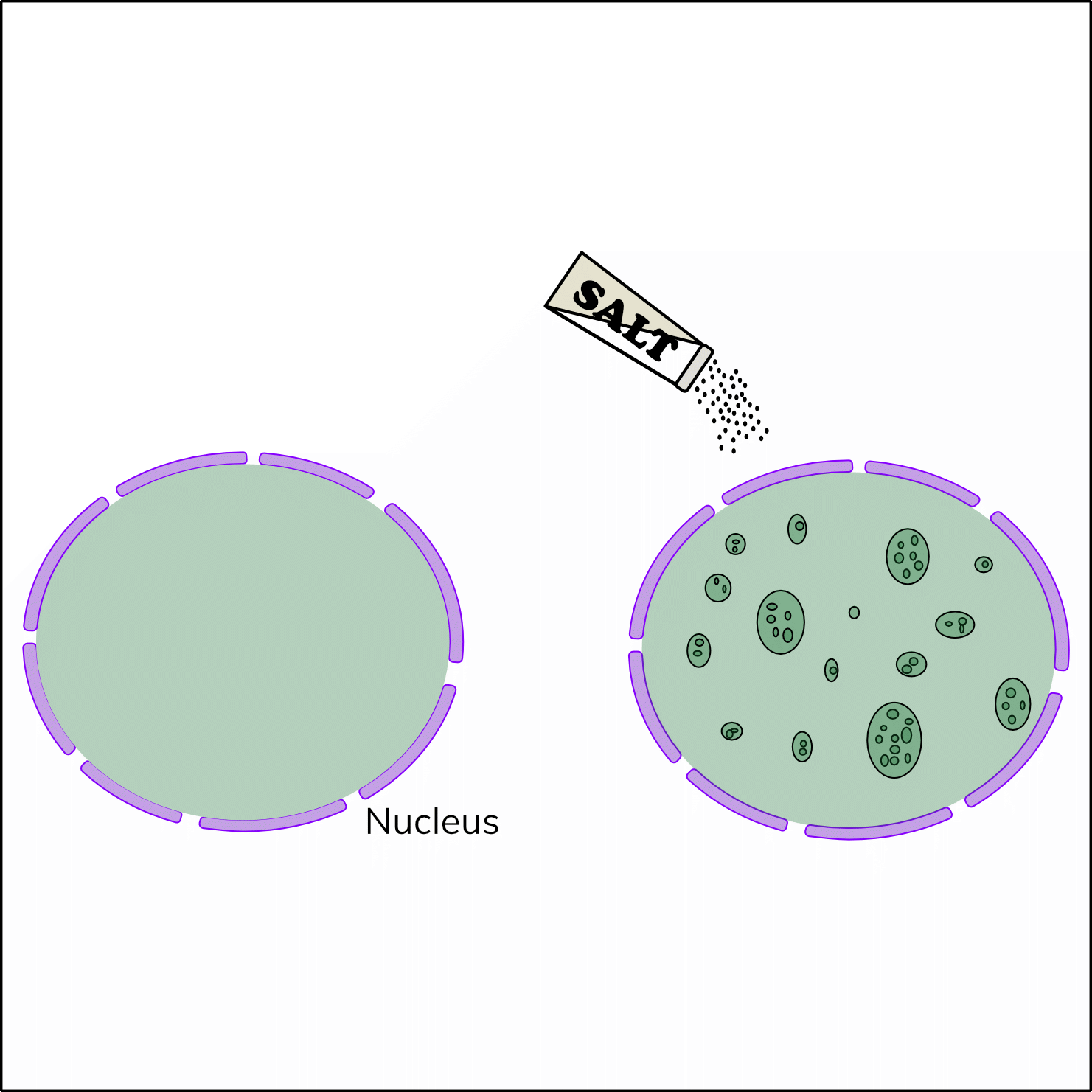
Phase separation is a fascinating trait that some proteins have. It allows them to under specific circumstances to behave like a liquid and create a little compartment for themselves inside the noisy environment of the cell. Now a new study from American researchers found that one such protein, TIME FOR COFFEE, does so when triggered by salt and in this way regulate salt stress response genes.
TIME FOR COFFEE is an intriguing protein, not just because of its name. This protein is crucial for a good working circadian clock. Without it the plant assumes the day is roughly 21 hours and has a constant jetlag in our 24-hour world.
But that is not all. In contrast to most proteins of the circadian clock TIME FOR COFFEE isn’t active in an oscillating rhythmic wave. It is always there. The other part that makes it intriguing is that it is lacking an ordered three-dimensional structure.
Droplet forming
That last part intrigued the researchers of the study of today’s paper highlight. Adding a fluorescent label to the protein the researchers noticed that this protein accumulates in speckles in the nucleus of Nicotiana benthamiana cells.
Upon isolating the protein, the researchers noted the formation of droplets in the solution that contained the protein, as if it contained a second liquid. Upon a closer look it appeared that these droplets were actually the protein behaving as a liquid. But it did so only when there was salt in the solution. Suggesting that TIME FOR COFFEE can phase separate.
To find out how this is relevant for the plant, the researchers looked at tale cress plants (Arabidopsis thaliana) with and without the TIME FOR COFFEE protein. Under normal circumstances no speckles could be found.
But remembering that salt caused the droplet formation, the researchers looked at the effect of salt. In plants growing in a salty environment the protein did form the speckles. But that was not all. When the plants missed the TIME FOR COFFEE protein, they died when growing in a salty environment. Suggesting that TIME FOR COFFEE helps the plant to respond to salt stress. This was confirmed by the lack of activation of salt stress response genes in plants without the TIME FOR COFFEE protein.
Luring the guard away
Now the question was, how could this protein, that prevents plants from having a constant jetlag, affect the activity of these salt stress response genes. One thing the researchers noticed was that under normal circumstances the salt stress response genes are pretty locked up, but that salt stress opens the door, so that they could become active.
The protein that keeps the salt stress response proteins locked up is HD2. This let to the researchers wondering if HD2 could interact with TIME FOR COFFEE. They found that outside the plant, TIME FOR COFFEE could lure HD2 into its droplets. Inside the plant the two proteins only came together in plants grown in salty environments, but not like they were best friends.
So, this suggests that in salty environments TIME FOR COFFEE forms phase separated droplets which can lure HD2 proteins to join them. This stops salt stress response genes from being locked up. And allows the salt stress response genes to become active and help the plant dealing with salt stress. Phase separating proteins are thus able to quickly form temporally compartments in which they can hold other proteins, making those temporally unavailable.
Literature
Wenwen Tian et al., TIME FOR COFFEE coordinates phase separation and chromatin regulation for salt tolerance. Sci. Adv. 12, eaei1213 (2026). https://www.science.org/doi/10.1126/sciadv.aei1213

