
Closing the trap
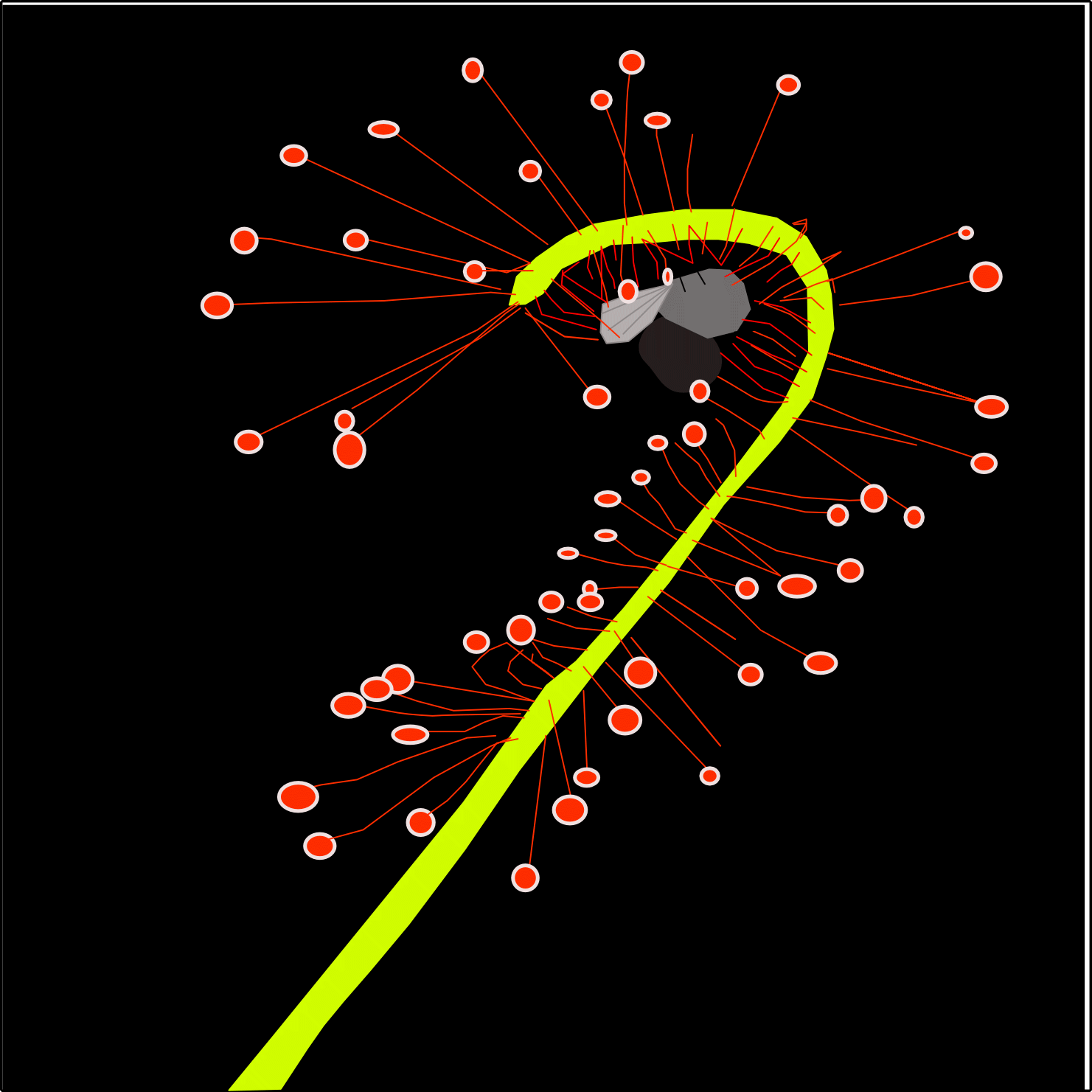
Carnivorous sundews actively capture their prey. But in contrast to the related Venus flytraps, sundews are not responding to touch or other mechanical stimulants. Now Chinese researchers show that a small peptide, glutathione, likely released by the captured fly, signals for the trap to close.
Carnivorous plants are a bit of an outsider to the plant family in that they capture animal prey. This alternative way of obtaining nutrients allow those flesh-eating plants to live in nutrient poor soils. Roughly two types of traps can be distinguished, those of plant that catch their prey in a more passive manner, like pitcher plants. And those that actively snare their prey, like the Venus flytrap and sundews.
Sundews have long sticky hairs or tentacles on their leaves which can ensnare insects. After having ensnared the insect sundew fold its leaf over the captured insect, stopping it from having any chance of wandering off. This happens slowly compared to the closing of the Venus flytrap. After about half an hour after a fly is captured on the sticky leaf, the leaf starts to bend. Then six hours later the leaf is completely bended over the insect.
Small peptide
For a long time, it is known that the closing of the sundews trap occurs not via touch, but via sensing something rich in nitrogen. The question was what. The recent findings that glutamate and glutathione in non-carnivorous plants are involved in insect defence, made the researchers wonder if a similar detection mechanism may underly prey detection in sundew plants.
When the researchers applied nitrogen rich substances, like crushed fruit fly paste or milk, to sundew leaves first the tentacles bend over the nitrogen rich droplet, which is followed by the folding of the leaf over it. Subsequently the researchers set out to test individual amino acids and the three amino acid long peptide glutathione. While applying individual amino acids did not result in trap closure, applying glutathione did.
Trying to find out more about how glutathione activates trap closure, the researchers inhibited glutathione formation in the plants. In those plants, glutathione levels severely decreased. Furthermore, the traps in those plants did no longer respond to crushed or living fruit flies. Only when the researchers provided a glutathione precursor to together with the crushed fruit flies did the trap close. Suggesting that passing a certain local glutathione threshold is required before trap closure is initiated.
Also closes the Venus flytrap
To find out if glutathione in carnivorous plants similar to non-carnivorous plants also elicit calcium signalling to activate the response, the researchers blocked calcium signalling. In those plants, glutathione, crushed, or living fruit flies could no longer induce trap closure. Suggesting that calcium signalling is indeed involved in telling the trap to close.
Lastly the researchers set out to test if glutathione could also close traps of other carnivorous plants. First, they tested this on other sundew species, which indeed responded similar to the sundew species that was used for this study. Then taking it one step further, the researchers tested if glutathione could also initiate trap closure in the Venus flytrap. This was also the case. Although it was not the hap-snap closure that is seen in response to a fly touching its trigger hairs. But a slow closure more similar to the sundew traps.
Together this suggest that carnivorous plants which actively capture prey have repurposed the ancient insect defence response pathway for prey detection.
Literature
Rui Li et al., Glutathione induces trap closure for carnivory in Cape sundew. Sci. Adv. 12, eadz2809 (2026). https://www.science.org/doi/10.1126/sciadv.adz2809

