
Buffering genetic variation
Most genetic differences within species, two Arabidopsis (tale cress) varieties have between 300000 to 400000 of those, about 0.2 to 0.3% of their genome, do not result in a phenotype. Instead, their effects are buffered away. One of the ways plants and other organisms do this is by providing help with protein folding, preventing misfolding. Now a group of Chinese scientists have found a potentially second way plants do this, via their spliceosome.
Genes of plants, like those of all eukaryotic organisms, contains introns, bits of sequence that don’t contribute to the protein the gene encodes for. In the process of creating the messenger RNA, the recipe card from which is used during the synthesis of the protein, those introns are spliced out by a protein complex called the spliceosome. This seems a bit complex, why not just have genes without those introns. But because of this pre-messenger RNA processing, the cell can make slightly different versions of the same protein without having to have a separate gene for each version.
Unexpected phenotype
One of the proteins that researchers of this latest paper where studying was a protein of the spliceosome called SKIP. While doing this they stumbled on something strange. Crossing plants with a defunct SKIP with a fully functional SKIP went fine, when the researchers use the same background variety. The second generation inherited the two versions of the SKIP gene as expected: 25% had two copies of the fully functional SKIP, 25% had two copies of the defunct SKIP, and 50% had one copy of each SKIP version. But when using two different background varieties only 9% of the plants of the second generation inherited two defunct versions of the SKIP genes. Leaving the researchers puzzled.
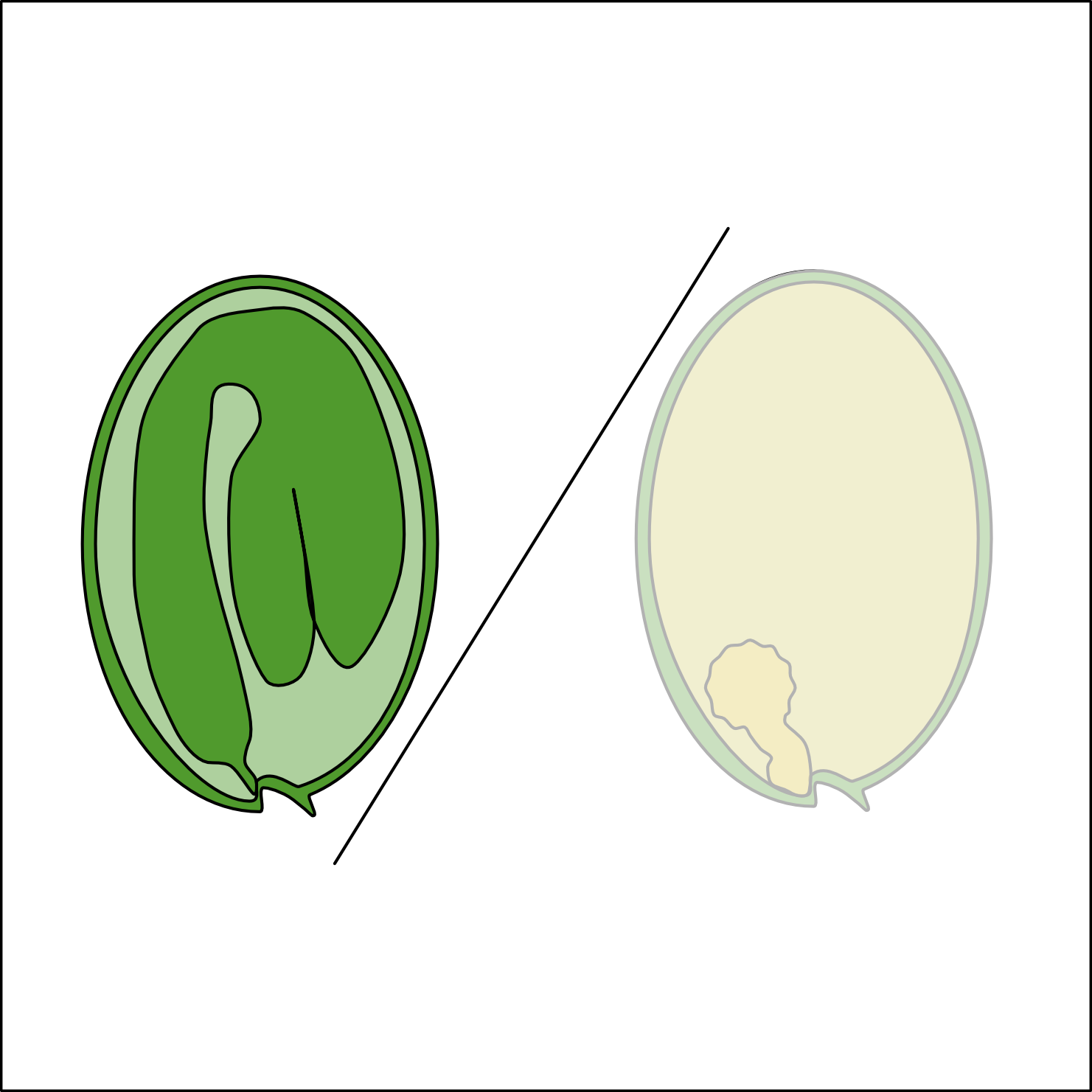
Looking closer the researchers noticed that there was no change in the chance of inheriting the defunct SKIP gene, but that seed development, when there were two versions of the defunct SKIP gene present, was often, but not always, aborted. Suggesting that a second gene was in play. After identifying this second gene, the researchers gave it the name Hidden Killer 1. Comparing the sequence of Hidden Killer 1 the researchers noticed that there where 6 differences between different varieties. One of these turned out to be the culprit of the aborted developing seeds.
Buffering mistakes
Now the question was how does a faulty SKIP result in bringing the phenotype of this completely different gene to the surface? To find out the researchers looked at how SKIP interacted with the pre-messenger RNA form of Hidden Killer 1. Noticing that it bound at the location of the offending gene variant difference but not at any of the other locations that were different. In addition, the researchers found that the splicing out of the introns of the Hidden Killer 1 pre-messenger RNA did not go according to plan when only faulty SKIP was present, resulting in a recipe card for the protein that stopped halfway. And it was this truncated protein that did the actual damage during seed development.
This suggests that the spliceosome, when fully functional, can kind of ignore the faulty instructions it comes across in the sequence of Hidden Killer 1. To prove that this was not the only time the spliceosome does this, the researchers inhibited the spliceosome from functioning properly in 15 different Arabidopsis (tale cress) varieties. This resulted in phenotypes that normally were not seen, and that were different in each of the different varieties. Suggesting that the spliceosome indeed can have a role in this. Although, like the authors of the paper say, to be sure requires further research.
Literature
Xudong Shang et al., Spliceosome buffers cryptic genetic variation to enforce phenotypic robustness in Arabidopsis. Sci. Adv. 12, eaed7513 (2026). https://www.science.org/doi/10.1126/sciadv.aed7513
 Plant en Zo