
Fuelling the repair
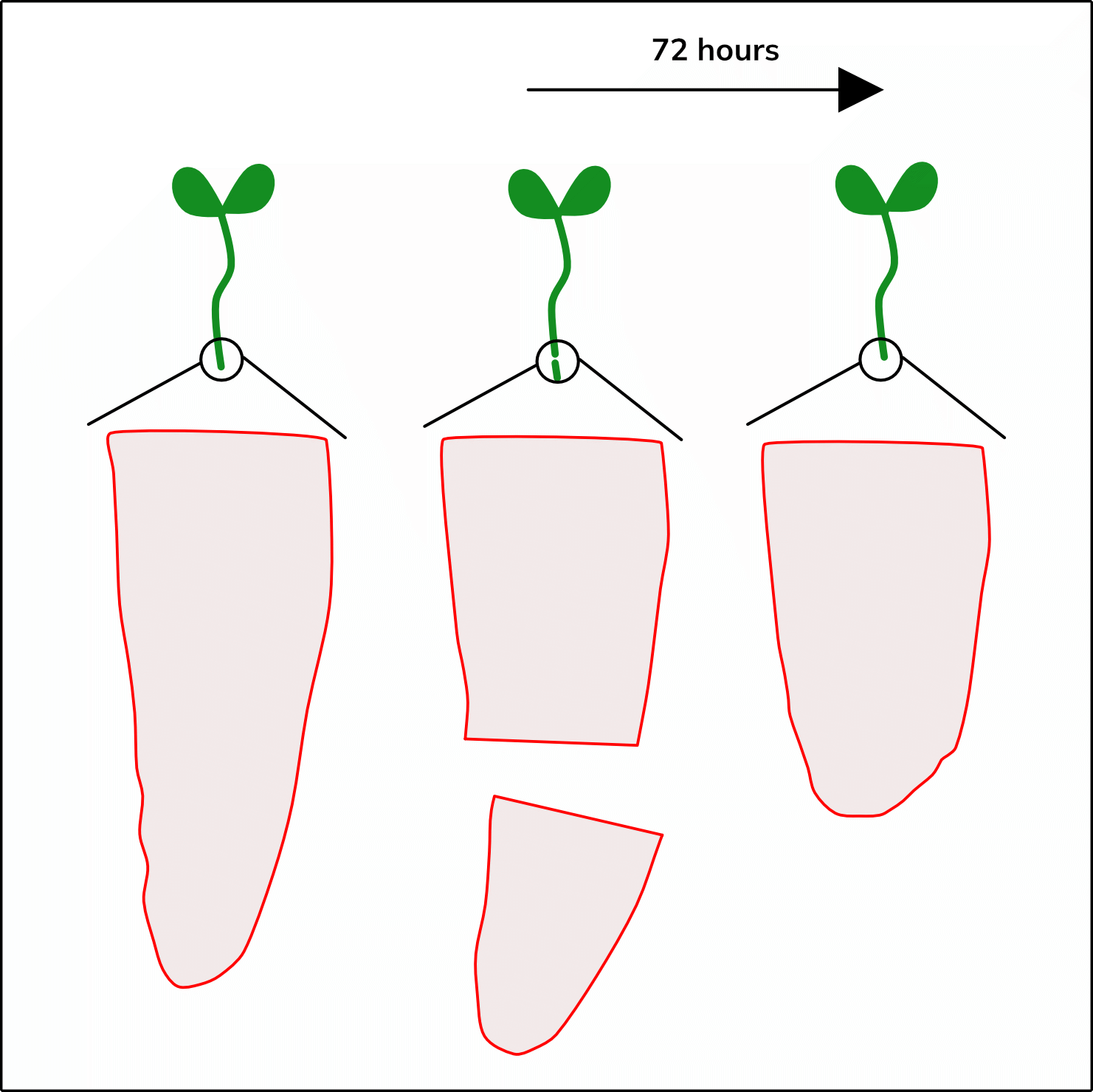
When plants are wounded, they quickly set to heal themselves. These unplanned cell divisions and growth require extra fuel. How the plant makes sure this fuel reaches the wound site is not clear. Now a new paper from Israeli scientists shows that while this extra fuel reaches the wound site in the form of sucrose, it is actually glucose that feeds the wound adjacent cells.
Wound repair is quick in plants. When a root-tip is decapitated, a new one is formed within 72 hours, that is within three days. And this is not some badly done rush job, the new root-tip looks and functions just like the old one. Now as you can imagen this requires a quick succession of cell divisions and cell growth. All requiring lots of fuel to keep them going. Knowing how the fuelling of the repair works, where its bottlenecks are, and how they can be overcome can help breeders with designing crops that quickly heal themselves after damage.
The authors of this new paper set out to figure that out. First, they looked if any readily available, through photosynthesis produced sugars, are needed. They checked this by blocking photosynthesis either chemically or by removing the leaves and looked if decapitated roots regenerated their root-tip, which they did not.
Accumulating sucrose
Following this they followed sucrose, the main product of photosynthesis, by using a sucrose sensor. Finding that in the first hours after decapitating the root-tip it accumulated near the wound-side, but not at it. Like it was prevented from going in.
Now there are some genes, the LBD genes, whose proteins function as bouncers at organ borders. Knowing this the researchers decided to check out sucrose flow and root-tip regeneration in plants without LBD genes. In those LBD missing plants sucrose indeed entered the wound site, but it did no good, the root-tips did not regenerate.
Now the question was how did the fuel enter the wound site? To get some idea of which genes might be involved in this and if they might hint towards an answer, the researchers looked at which genes were active at that time. Finding two families of genes, CWINVs and STPs, which are involved in the conversion of sucrose into glucose and glucose transport in the space between cell walls. The location of activity of these two gene families matched the sucrose location at the wound-site.
Glucose gets in
All these results suggests that sucrose is converted into glucose when it reaches that border it isn’t allowed to cross. To check this the researchers used a glucose sensor to follow the last stage of the fuel route. Finding that indeed glucose piles up at the wound-site. But only while the root-tip is regenerating. And only when CWINVs and STPs where present. Plants without CWINVs and STPs did not regenerate their root-tips as well, even if the researchers supplied sucrose or glucose.
Lastly the researchers checked what happened when the plant could use more STPs during wound healing. This sped up the healing process under normal, fuel limited conditions. When there was and abundance of fuel, the extra STPs actually worked against rapid repair.
So, wounded plants quickly repair the damage. They fuel this by supplying sucrose to the wound-site which just before it enters the cells that do the heavy lifting, is transformed into ready to use glucose molecules. It is likely this division of labour enables plants to repair the damage that quickly.
Literature
R. Matosevich, M. Della Zuana, I. Cohen, & I. Efroni, Wounding-induced redirection of sugar transport fuels tissue repair, Proc. Natl. Acad. Sci. U.S.A. 123 (25) e2535587123, https://doi.org/10.1073/pnas.2535587123 (2026).
Or for the BioRxiv version https://www.biorxiv.org/content/10.64898/2026.01.13.699335v1

