
Calling sign
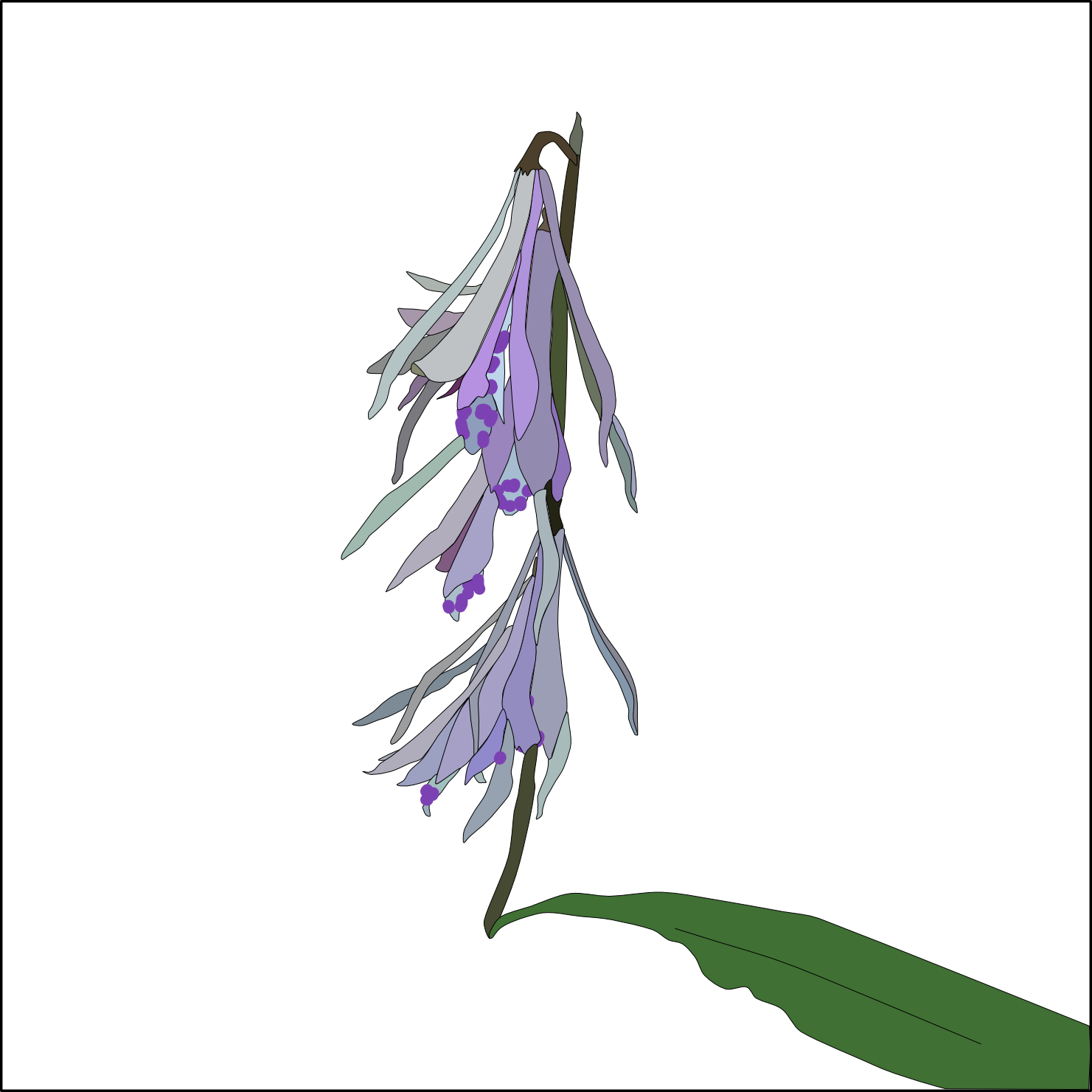
Orchids even before they germinate they are dependent on their symbiotic fungal partner. Their seeds lack the stored energy that seeds of other species have. Now Chinese researchers show that orchid seeds are not waiting for their fungus to arrive but actively entice them with signalling molecules doubling as carbon source.
In the symbiosis between orchids and their fungal partners the roles are clear. The orchids provide the carbon and the fungus provides the rest of the nutrients. But that is after their symbiosis is established. What about before that, the researchers decided to investigate that for the orchid Cremastra appendiculata and its symbiotic partner Coprinellus disseminates.
Calling out
Due to their tiny appearance and lack of energy storage it was initially believed that orchid seeds had to wait passively for the right fungus to turn up. And that the fungus provided all the initially required carbon. However there where signs that orchid seeds send out signals that allows its fungal partner to find it.
To confirm that this was indeed the case, the researchers grew their orchid seeds and fungus on the same plates. Noticing that the fungus grew its hyphae towards the orchid seeds. They also noticed that on media that contained the exudates that the seeds released, but not the seeds themselves, the fungus grew more than on control plates. Indicating that orchid seeds indeed release signal molecules that help the fungus to find it. In addition, the researchers also noticed those signal molecules also stimulate the germination of the orchid seed itself.
Double as nutrients
The researchers identified the two signalling molecules that the orchid releases as 4‐methoxybenzoyl glucoside and p‐methoxybenzoic acid. Both showed to promote the fungal hyphae growth and seed germination. Due to their close resemblance to molecules that the fungus is known to break down the researchers checked if this was also the case for the signalling molecules. Which was indeed the case, the fungus breaks down the signalling molecules so it can use their carbon as building blocks.
So orchid seeds not only let their symbiotic fungal partner know where they are. They also provide the fungus with their first taste of what is to come if they agree to the symbiosis. The question that remains is how do the orchid seeds know when to release those calling signs? Especially as those signs double as a germination stimulus. So, is the fugus calling first and are orchid seeds simply responding, or are the orchid seeds taking a big all or nothing risk when calling out of the blue?
Literature
Liu, Z., Wang, Y.-D., Xiao, B., Xu, C.-Q., Chen, Y., Liu, K.-P., Zhao, X.-H., Yang, J., Niu, J.-F., Xing, X.-K. and Ding, G. (2026), Phenolic exudates from orchid seeds as nutrients chemically attract fungi. J. Integr. Plant Biol.. https://doi.org/10.1111/jipb.70368

