
Linking defence responses
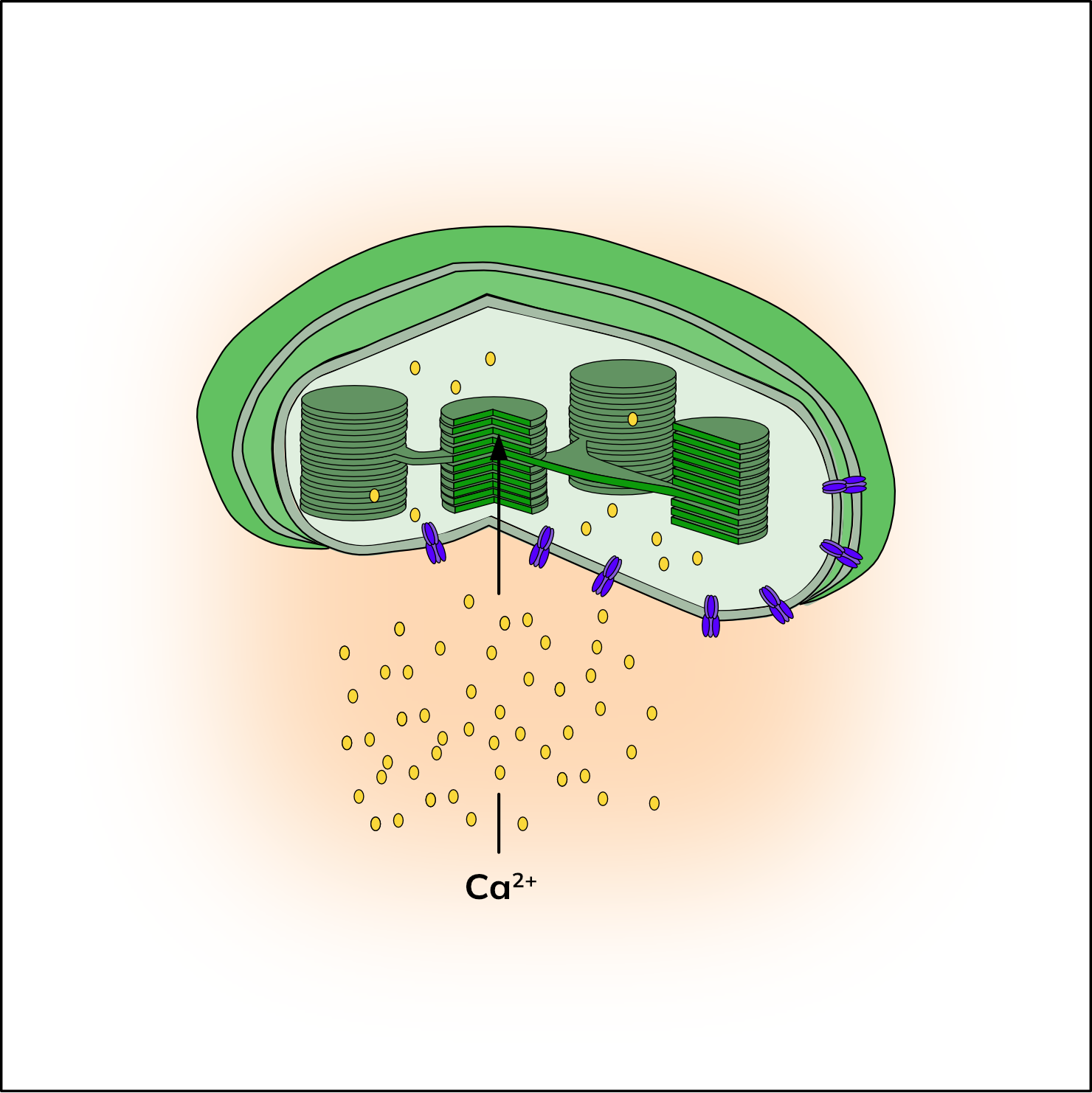
Upon wounding a Ca2+ signal travels from the wound through the plant. In each cell the signal passes through the defence response gets activated. Now a new study from German researchers shows that two plastid located ion channels form a missing link in how Ca2+ activates the biosynthesis of jasmonic acid, one of the plant hormones that coordinate the defence response.
Upon sensing stress, like wounding or an attack, plants respond by activating their defence response, which starts among others with the biosynthesis of jasmonic acid. The firs steps of which take place in plastids, like chloroplasts. While it is known that stress causes an increase of Ca2+ inside plastids, how Ca2+enters that fast and how it is promotes jasmonic acid biosynthesis unknown.
The recent identification of plastid located ion channels called PEC1 and PEC2 made the researchers wonder if these where the channels they were looking for. After confirming that these channels indeed transport Ca2+ ions across chloroplast membranes, they checked how much Ca2+ increased in chloroplasts during salt stress. Finding that just after the concentration of Ca2+ in the cytosol increases, the concentration of Ca2+ in the chloroplasts increases as well. What is more, this did not happen in plants without any PEC1 and PEC2. Those plants had more Ca2+ in their cytosol. Indicating that PEC1 and PEC2 are required for pumping Ca2+ from the cytosol into chloroplast at times of stress.
PEC1 and PEC2 required for defence
Next up the researchers analysed how the activity of PEC1 and PEC2 genes is regulated. Zooming in at that part of sequence that regulates the activity, they found binding places for gene regulators known to be part of jasmonic acid regulated defence responses. Subsequently the researchers checked if jasmonic acid indeed activates PEC1. Showing that upon application of methyl jasmonate the PEC1 gene was activated. Furthermore, activating PEC1 resulted in more PEC1 protein. What is more, treating plants with methyl jasmonate the researchers found increased the Ca2+ level inside chloroplasts, but only when PEC1 and PEC2 are present. This suggests that the amount of Ca2+ that enters the chloroplasts is dependent on the number of PEC1 and PEC2 ion channels present.
Following this, the researchers wanted to find out how important PEC1 and PEC2 are for amounting the defence response. They did this by looking at the active genes in control plants and in plants without PEC1 and PEC2 under normal and after wounding. This showed that in plants without PEC1 and PEC2 the activation of defence response related genes was mostly similar to the plants with PEC1 and PEC2. However, the production of jasmonic acid was reduced in plants without PEC1 and PEC2. Suggesting that a full-blown defence response, for which an increase of jasmonic acid is required, was not possible in plants without PEC1 and PEC2.
Prepared to defend
Lastly, they checked what happened when plants have higher base levels of PEC1. This, although affecting the size of the plant, made the plants more sensitive to jasmonic acid. Which turned out to be a positive thing when the plants got infected with the fungus Botrytis cinerea. Plants with higher base levels of PEC1 developed smaller lesions that those with normal base levels. Indicating that fungus growth and spread is inhibited.
So, PEC1 and PEC2 bring the calcium ions there to where they are needed to promote jasmonic acid biosynthesis. In turn jasmonic acid promotes the activity of the genes encoding PEC1 and PEC2. But equally important without PEC1 and PEC2 there is no full-blown defence response. Indicating they are a indeed a link between Ca2+ current and jasmonic acid signalling.
Literature
S. Mühlbauer, et al., (2026) PLASTID ENVELOPE ION CHANNELS (PEC1/2) link Ca2+ and jasmonic acid signaling in plant cells, Proc. Natl. Acad. Sci. U.S.A. 123 (35) e2525536123, https://doi.org/10.1073/pnas.2525536123

