
New clues on Norway spruce reproduction
Norway spruce (Picea abies) spends its first 25 years or so of its life as a juvenile, and after that only reproduce ever 3 to 5 years. Not surprising, researchers wanted to know more about which genes are involved in the transition towards cone and seed production. Knowing this will potentially help with speeding up breeding new varieties, which for example are better suited to the changing climate. But being a slow reproducing tree with a complex genome makes this all in all complex.
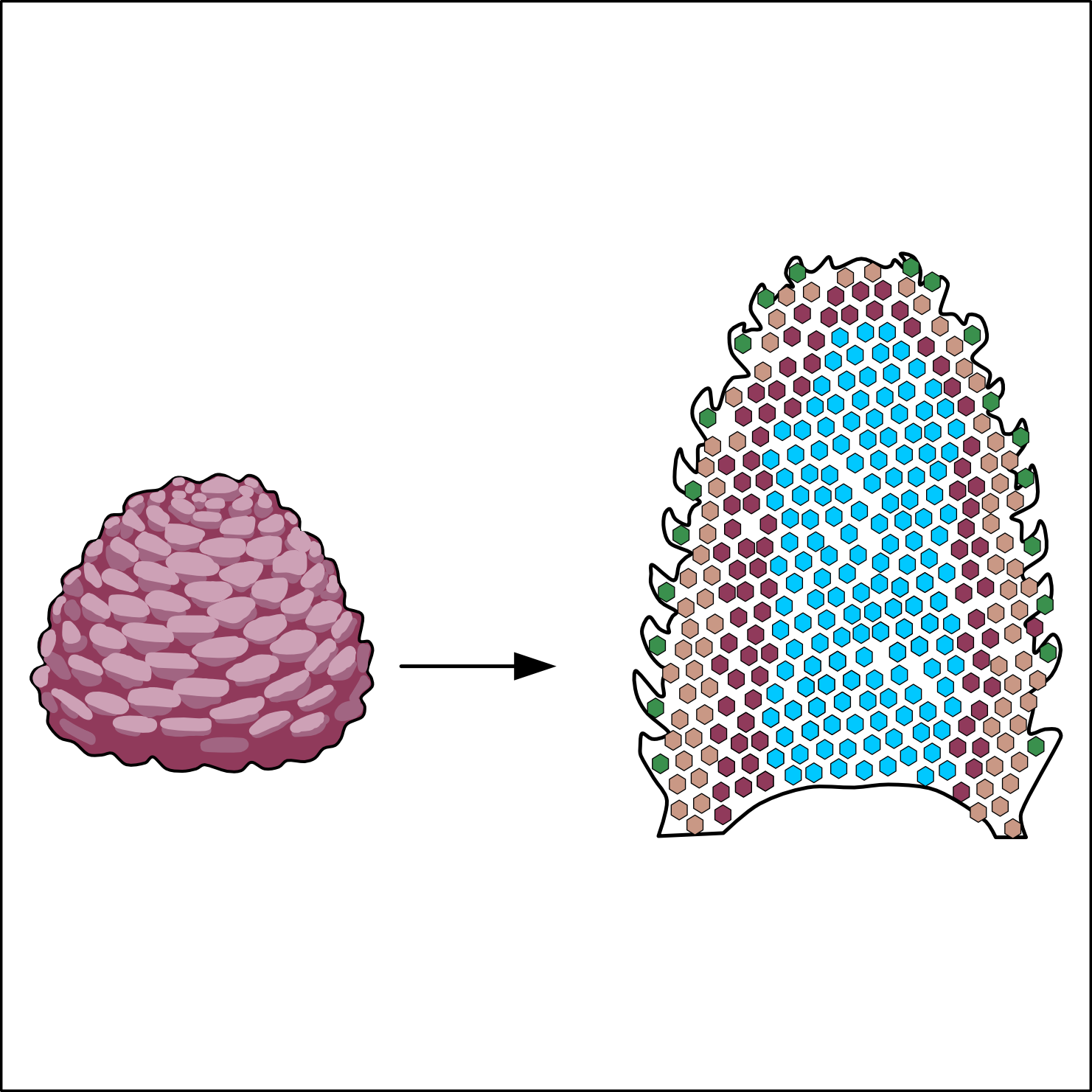
Now Swedish researchers have found a way to gain insights in this tree transitioning from vegetative organ development towards cone development. Key to this was the development of a technique they called spatial transcriptomics. Spatial transcriptomics basically looks at the gene activity of small (in this case they got a 55µm resolution, and a 1µm is 0.001mm) sections or cubes across a tissue. From this the researchers can then place on a map of the tissue so they can see exactly in which bit of the tissue which genes are active.
Zooming in
Doing this allowed the researchers to distinguish which genes are active in the inner pith vs the vascular tissue and the outer developing lateral organs. Giving them a colourful map of all the different cell types in the tissue sample they analysed.
In this case, as the researchers wanted to know more about what genes are involved in the transition from vegetative tissue towards reproductive cone tissue, the researchers looked at developing shoot tissue at three different time points during this transition.
After having done the initial spatial transcriptomics and analysis the researchers zoomed in on a gene known from earlier studies to be involved in the transition from vegetative to reproductive cone, the gene activator SPL1. And as it is known that SPL1 is negatively controlled by miR156 and miR529, the researchers included these as well.
Creating a genetic model
First thing they did was checking the gene activity of these genes. Finding that the gene activity of SPL1 is low in vegetative tissue but high in the developing cones. For miR156 and miR529 the opposite was found.
Next, the researchers looked at the spatial transcriptomics data to find the genes whose activity correlated with the gene activity of SPL1. Identifying two gene activators, DAL14 and the up till now unknown DAL55. Both DAL14 and DAL55 were active when SPL1 was active and showed low activity when SPL1 activity was low. This suggests that DAL14 and DAL55 could be activated by SPL1, and that both genes are important for cone development
The researchers tested if SPL1 could potentially activate DAL14 and DAL55. Which it could. But that is how far the researchers were able to dive into the molecular mechanism of how Norway spruce is regulating its transition from vegetative towards reproductive cone tissue.
Next up will not only be to expand the genetic model of cone production initiation but also trying to find out what triggers the transition from vegetative towards cone tissue. So, what inhibits miR156 and miR529 activity. This especially might help with attempts to speed up breeding novel varieties that might be better suited to the changing climate.
Literature
Saarenpää et al., Norway spruce spatiotemporal programs of conifer reproductive development, Cell (2026), https://doi.org/10.1016/j.cell.2026.08.033

