
Feeling the wound
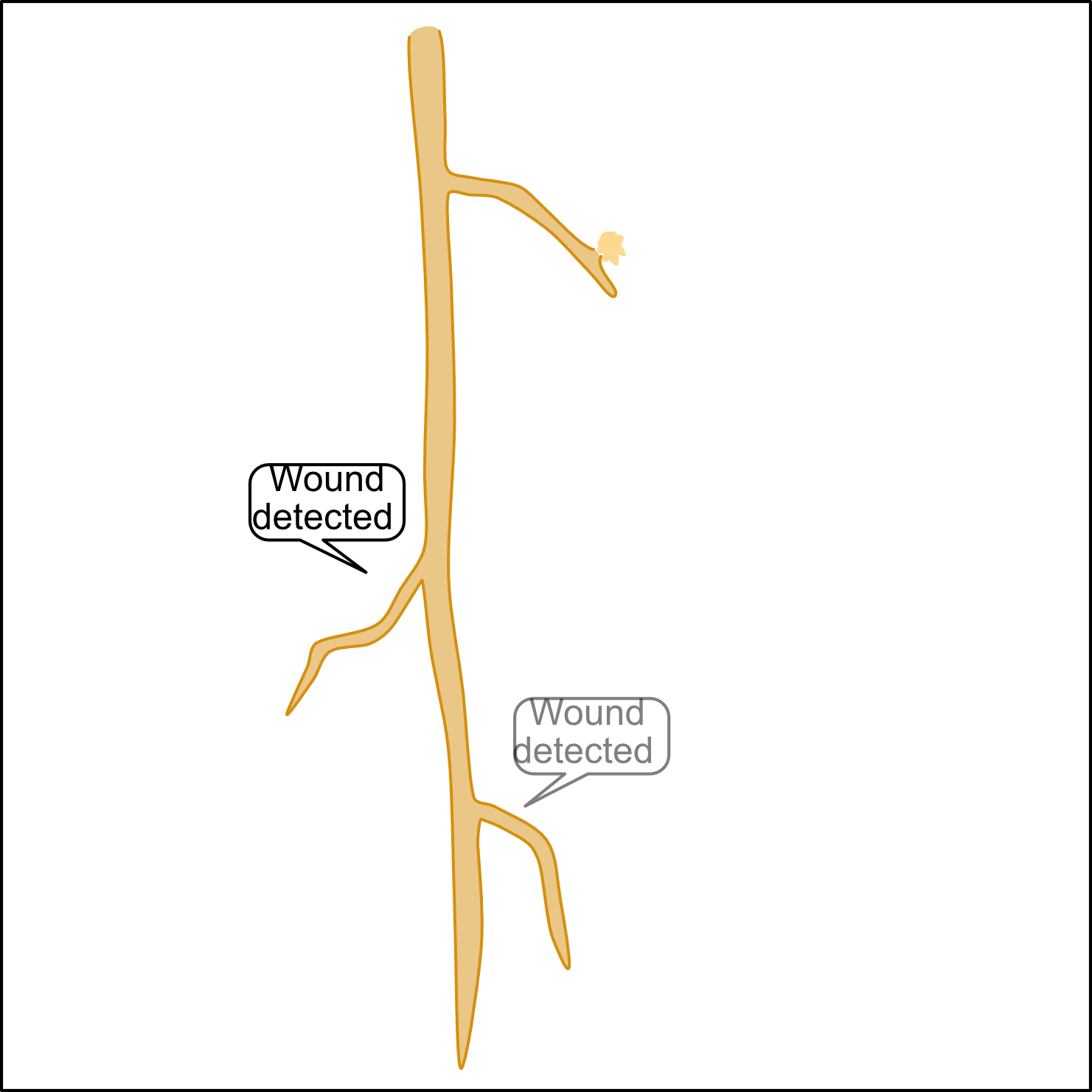
Roots are just as likely to be damaged by hungry insects as the rest of the plant. But while lots is known about how plants respond to above ground damage, below ground this is still in the dark. A group of international researchers set out to find out more.
Wound response can be roughly divided into two parts. The immediate defence response at the wound site and systemic responses that tell cells and tissues further from the wound site what is going on. This latest study on wound response in roots is about that second type of wound response.
So how is that systemic response happening in above ground tissue. There are electrical and calcium signals that are quickly telling other leaves that there is for example a caterpillar nibbling on a leaf. Previous studies were able to show that these signals move like a passing wave from the wound site through all the above ground parts of the plant.
Reduced reach
When the researchers of this current study looked at electrical and calcium signals moving through the roots after wounding, they found that they travelled less far than what was previously observed for above ground tissue. In above ground tissue the signal travelled centimetres, while in roots the signal only managed a couple of millimetres.
When wounding one lateral root, other lateral roots were notified, but the farther away the lateral root from the wound, the weaker the signal. A bigger wound though, caused a bigger signal.
The researchers assume that plants restrict the distance of their wound signalling in roots because of insects that cause damage to roots have to travel through dense soil to reach farther away located roots. So, those insects are less likely to damage those farther away tissues.
Detecting the wound
Electrical and calcium signals are initiated only after detection of the wound. Plants detect wound through detecting its debris. Part of this debris are the molecules glutamate, ATP and H2O2.
When the researchers applied either of those molecules to the roots, they noticed an electric signal traveling through nearby root tissue. However, only glutamate could make the electric signal travel to farther away root tissue. Suggesting that it is glutamate detection that initiates the electric signal
The researchers were still a bit puzzled about what could enable the electric signal to travel that fast. Realising that plants are good at detecting pressure differences and that pressure waves could travel fast, they decided to test if this was the cause.
Bubbles in cells
To test this, they used a cool technique that allowed them to create minuscule bubbles within root cells. Now the size of these bubbles depends on the pressure inside the cell, less pressure means bigger bubbles. So, by measuring the changes in bubble size the researchers had a way of detecting pressure changes within cells.
In undamaged roots the size of those minuscule bubbles did not change, but a wound in a neighbouring lateral root did. That increased the size of the bubbles, suggesting a drop in pressure.
Lastly the researchers wanted to know how the plant detected these cell pressure changes. Plants have multiple mechanosensitive ion channels that can do the job. The researchers tested two of them. Both could translate the sensed drop in pressure into an electrical signal. Neither it turned out where needed for the local signal. But one of them, MCA1, was required for the electrical signal to travel farther away from the wound site.
So, what do we know now about how plant roots respond to wounding. Firstly, they do tell neighbouring roots about the wound, but only those in close vicinity. The signal responsible for the warning likely comes from the glutamate that neighbouring cells detect in the wound debris. The signal then travels via a combination of a reduction of cellular pressure and an electrical signal through the root.
Literature
Angel Baudon et al., MCA1 mechanosensitive channels enable fast communication of wound signals between lateral roots. Sci. Adv.12, eaef2202 (2026). https://doi.org/10.1126/sciadv.aef2202

