
Why seedlings don’t immediately give up in the shade
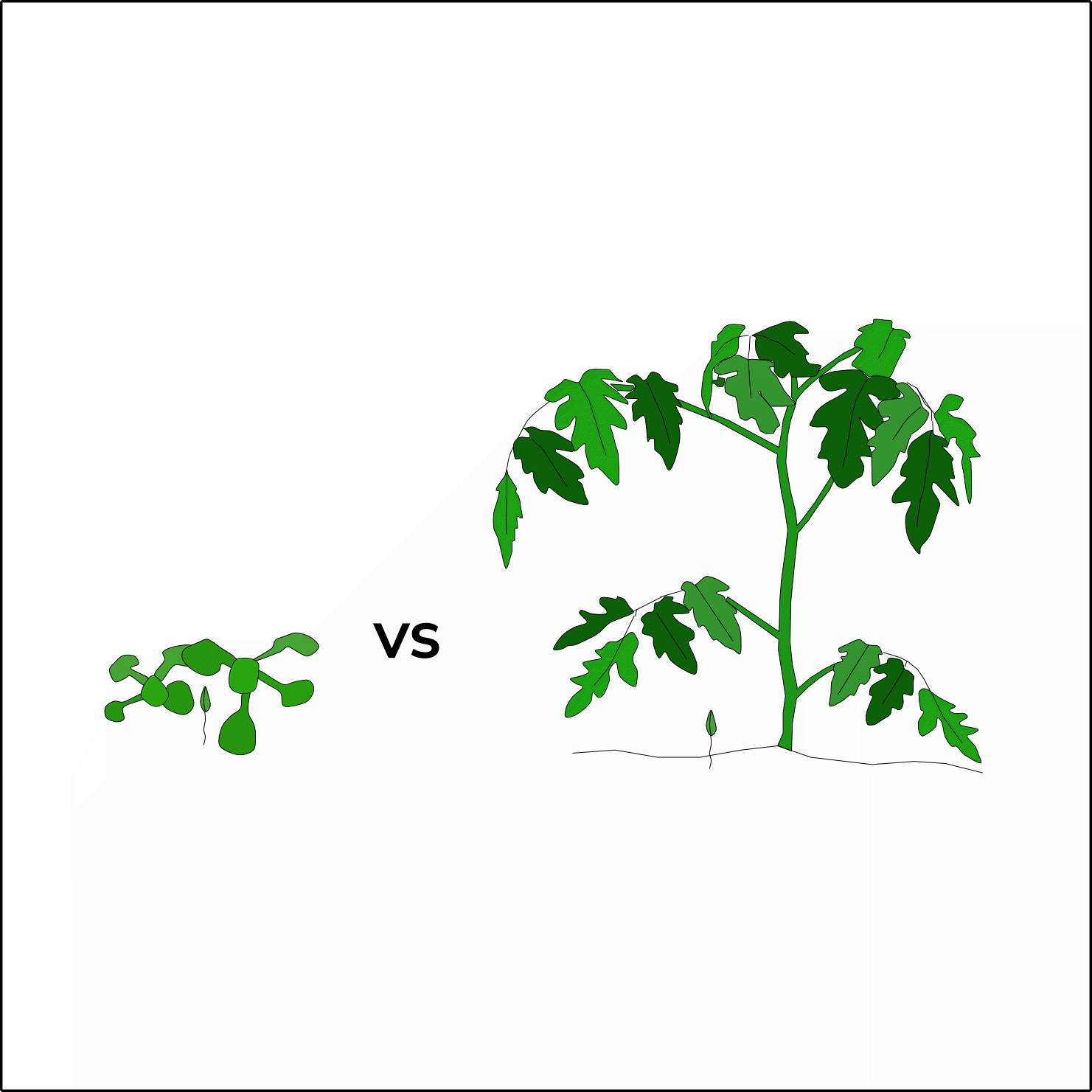
For plants it is important to distinguish between shade from neighbouring plants which they can outgrow, and canopy shade that they can’t. One of the ways plants distinguish between those two is via the age of the plant. Whereby seedlings are given the chance to outgrow the shade. Now a new study by British and Dutch researchers shows how those seedlings inhibit the canopy shade adaptation strategy.
But before we go on to what the study exactly found, lets first discuss how plants in general distinguish between those types of shade.
Plants recognise if they are standing in the shade by the state of their phytochrome receptors. Phytochrome receptors can detect both red and far-red light. The latter is an indication of light that has travelled through leaves. The phytochrome receptor that plays a pivotal role in regulating shade response that plants can outgrow is called PhyB. This receptor is active when it detects red light and inactive detecting far-red light. When active it travels to the nucleus where it prevents PIF7 from activating the shade outgrow genes.
For detecting canopy shade that they can’t outgrow, plants depend on PhyA. This photochrome is active when it detects far-red light and inactive in red light. Like its PhyB counterpart it travels towards the nucleus when active, although this time with some help. In the nucleus PhyA activates the genes needed for responding to shade a plant can’t outgrow.
Now this new study shows that once in the nucleus, when PIF7 is present, it also interacts with PIF7. And this with PIF7 interacting PhyA can’t no longer activate the canopy shade response genes. But PIF7 does more. It not only traps PhyA but also the proteins that helped PhyA getting into the nucleus. So, it is effectively blocking other active PhyA proteins from getting into the nucleus where the need to be to do their job.
So how did the researchers find this out?
First, they checked if PIF7 influences the activation of canopy shade responses. They did this using Arabidopsis (thale cress) plants with either no functional PIF7 or with extra PIF7. They showed opposite effects, but both came down to that PIF7 counteracts the effect of PhyA. Especially striking is that extra PIF7 suppresses PhyA action.
Next, the researchers found that this was not simply due to PIF7 changing the protein abundance of PhyA. Instead PIF7 interacts with PhyA to form so called nuclear photobodies. And it is this interaction that blocks PhyA from activating canopy shade response genes.
Subsequently, the researchers also tested if PIF7 interacts with the proteins that help PhyA get into the nucleus. Which PIF7 does indeed, which is shown by the co-purification of those proteins using PIF7 as a bait.
Lastly the researchers show the importance of preventing PhyA from getting into the nucleus. Using a PhyA protein with a tag that directs it into the nucleus, the researchers found that the effect of PIF7 was much smaller than when it also could block PhyA from getting into the nucleus.
Together this shows that PIF7 not only interacts with PhyB but also with PhyA. And that it does so to prevent the canopy shade response from getting the upper hand. For the future it will be interesting to find out under what circumstances PhyB gets the upper hand of PIF7.
Literature
M. Zhou, A. Romanowski, M. Valdivia-Cabrera, & K.J. Halliday, (2026) PHYTOCHROME INTERACTING FACTOR 7 moderates the activity of phytochrome A in persistent canopy shade conditions, Proc. Natl. Acad. Sci. U.S.A. 123 (46) e2613044123, https://doi.org/10.1073/pnas.2613044123

