The sensing of salt


The sensing of salt

How  plants sense salt has at last been deciphered by the group of Zhen-Ming Pei. For their last publication in Nature they went on the hunt for mutants that did not show salt induced Ca2+ spikes. This resulted in the identification of a mutant they named moca1 for monocation-induced [Ca2+]i increases 1.  moca1 is hypersensitive to salt stress. One of the reasons is that, unlike wildtype plants who through activation of the SOS-pathway try to actively export Na+ from the cell,  moca1 plants don’t do this.

They found that moca1 had a mutation in a gene encoding for an enzyme in the pathway of the biosynthesis of membrane lipid called glycosyl inositol phosphorylceramide or GIPC for short. GIPCs are located at the outside of the plasma membrane and have a negative charge. Analysing the levels of GIPC in moca1 plants showed that they were reduced. However, when grown under optimal conditions it was not possible to distinguish moca1 from wildtype, only under salt stress conditions moca1 showed a phenotype. This suggested that while the levels of GIPC in moca1 plants were low, they were high enough to survive under normal conditions. But that under salt stress conditions higher levels of GIPC are needed.

Being puzzled by this, the researches subsequently analysed how GIPC could play a role in salt-induced increases of Ca2+ in the cell. Revealing that in the abcense of GIPC the cell-surface potential is not affected by NaCl, while NaCl does have an effect on the viability of the cells. Furthermore, they show that Na+ bind to GIPC outside the cell. The combination of these results they link to the opening of Ca2+ channels needed for the observed Ca2+ influx upon NaCl perception. Although, upto date it is not exactly know how the opening of Ca2+ channels in plants is regulated.

In the accompanying review of this article an alternative model was suggested that the binding of Na+ to GIPC would result in the formation of a microdomain in the plasma membrane. This microdomain would contain in addition to GIPC, Ca2+ channels also signalling proteins. In the alternative model it was proposed that some of these signalling proteins then activate the Ca2+ channel.

While it is possible that the binding of Na+ to GIPC leads to microdomain formation,  it adds one extra step to the process.  And as Occam’s razor reminds us, the simplest option is often the best.  Therefore, if there needs to be an alternative model to that of the authors mine would be that under non-stress conditions GIPC is bound to Ca2+ channels, thereby inactivating them. However when Na+ levels rise Na+ outcompetes the Ca2+ channels for GIPC binding. Releasing the inhibition from the Ca2+ channels, allowing them to open.

Whatever model turns out to be true, the groups of James Siedow and Zhen-Ming Pei have done great work to show us how Na+ is perceived by the plant and that disruption of this perception results in an absence of the Ca2+ signal needed to alert the rest of the plant that it is under salt stress.

Great talk about Cross-kingdom RNAi by Hailing Jin


Great talk about Cross-kingdom RNAi by Hailing Jin

Last week we were treated by a fantastic seminar from Hailing Jin from the University of California. In the over-airconditioned seminar room we quickly forgot about the cold while she introduced us in the world of cross-kingdom RNAi and small RNA trafficking between plants and fungal pathogens. She started with telling us how small RNAs are formed from their precursors using Dicer-like (DCL) proteins and how these small RNAs are incorporated into AGO proteins to induce gene silencing, which we call RNA interference (RNAi). And how RNAi is a conserved regulatory mechanism across almost all eukaryotic cellular processes. We then were introduced to her pathogen of choice in her study of plant-fungal pathogen interaction, Botrytis cinerea (Bc). Bc is actually around us in the air and is probably the one you see when your fruit of veg has gone mouldy. However, the main reason she used them is that the have their own small RNA machinery and can thus process small RNAs by themselves. Part of the way how Bc infects plants is that after penetrating the plant cell, Bc secretes small RNAs into the plant cell. These Bc-small RNAs are then loaded by the plant onto its own AGO machinery, which then will silence the genes targeted by the Bc-small RNA. The result of this is an inhibition of the plant immune response, enhancing the virulence of Bc. Subsequent research by her and other groups has shown that similar mechanisms are used by fungi infecting mammalian cells, as well as by parasitic plants and bacteria and their interaction with their host.

Hailing Jin told us then the realisation that if small RNAs can travel from fungi to plant, they supposedly should be able to travel into the other direction as well. The trouble with this was that in order to be able to show that an organism has received small RNAs from another organism you need to be able to separate the two organisms from each other, before the isolation of RNA. As both plants and fungi have cell walls, which actually consist of different compositions, the separation should be possible using sequential protoplast purification. So she convinced a postdoc to give it a try or actually “Give it three tries, as when you try something new you might fail the first time, but with troubleshooting you will succeed the second or third time.” Therefore, with some tries a postdoc from her lab was able to do this by isolating Bc-protoplast from infected leaves. Subsequent analysis of the small RNAs of these Bc-protoplasts showed that not only they contained small RNAs originating from plants, but also that these small RNAs where actively transported to the fungal cells.

In the following quest to find out how these plant-small RNAs were delivered to the fungi Hailing Jin looked into the possible delivery options that are known. One of these are extracellular vesicles, which have been implicated in the transport of small RNAs in mammalian cells. In order to find out if in plants these extracellular vesicles contained small RNAs they collected the extracellular fluid from the phloem from both control and Bc infected leaves. This showed not only that these extracellular vesicles contained small RNAs, but also that when coming from Bc-infected leaves that these small RNAs matched those found in Bc-protoplast from infected leaves. They then went on to confirm that these extracellular vesicles are exosomes, by showing that the plant exosome markers TETRASPANIN (TET), TET8 and TET9 are induced by Bc infection. Using TET8-GFP, they show that TET8-GFP accumulates at the infection site, were TET8-GFP labelled vesicles are secreted. Subsequent analysis of the uptake of these vesicles showed that they are readily taken up by Bc. To confirm that TET8 and TET9 are required for the vesicles transporting the small RNAs they created plants with a reduced expression of TET8 and TET9, and infected these plants with Bc. Not only were these plants now more susceptible to Bc infection, they also had a reduced transfer of plant-small RNAs to Bc. Indicating that the small RNAs that the plant transfers to Bc contribute to its defence against Bc. They then looked into which genes the plant-small RNAs targets in Bc. It turned out that a lot of these genes were actually involved in vesicle trafficking.

Haining Jin went then on to discuss that small RNA trafficking is a level of communication across-species, and how we can use this for plant protection from fungal pathogens. As this is an interesting topic that deserves a post on its own I will talk about that in more detail later. But I will finish with giving you the links to  Haining Jin’s articles including those discussing how cross-kingdom RNAi can be used for plant protection.

References

Weiberg et al., Science, 342:118-23, 2013
Cai et al., Science 360:1126-29, 2018
Weiberg et al., Current Opinion in Biotechnology, 32:207-215 2015
Huang et al., Cell Host and Microbe, 26: 173-182, 2019
Wang et al., Nature Plants 2:16151, 2016

A case of plant blindness


A case of plant blindness

Most scientist working on plants would have noticed at some time that plants are ignored by a lot of other life science researchers. Sometimes it will be during a talk whereby the presenter say something along the line ‘in all eukaryotes we have gene family X’ while you know gene family X is absent in plants. Other times it will be when reading and article whose topic is spans a broad range of living organisms. The later happened with me lately when reading an interesting article about phosphoinositides. Plant blindness is the term that has been coined for this kind of ignorance and ignoring. And there has a lot of talk on the internet among plant scientists about plant blindness.

At first I did not intend to write about that here so soon, but reading that review article made me change my mind. The thing is a review article is summarising all what is known about the topic, in this case phosphoinositides. A lot of the time when something falls outside the scope of the review the authors will to say so and when possible refer were the reader can go to if they really want to know more about that topic. As a researcher we use review articles to get an overview of the research that has been done. Starting out in a new topic it might be used as a guide to get to know that topic.

So the review that I am reading is talking about phosphoinositides in the context of mammalian cells and assumes that the reader reads the review because it is also interested in phosphoinositides in the context of mammalian cells. So far so good would you think. Except for the nice little summary table about the different phosphoinositides, their abundance and where we can find them in the cell. This table is labelled ‘Abundance, location, measurement and roles of phosphoinositides in eukaryotic cells’, this means that they claim that the data they present here is correct for not only mammalian cells, but also yeast, insect, plant cells, etc.. This, however, turned out not to be true. Working on phosphoinositides in plants have taught me a few things. The over all message is that plants do things slightly differently. Firstly, the abundance for some of the phosphoinositides in plants is different compared to what is known for mammalian cells. And secondly,

some proteins of the phosphoinositide pathway that we known from mammalian cells are absent in plants.

For the phosphoinositides community to belief and accept that things are different in plants took time. After a combination of having multiple plant genomes sequenced, and a number of publications telling things are different in plants. We are finally at a stage that we plant researchers can say with confidence:

‘No, it is not behaving the same as in mammalian cells, we are not sure what is going on in stead but we belief it is like …’.

It takes time to get to this stage. It can also make reading articles from the time when they did not know what was going on confusing. It is therefore damaging to have a new review article just ignoring this difference between plant and mammalian phosphoinositides. Anyone new in the field will come away with the believe that phosphoinositides are organised/regulated similar in mammalian and plant cells, therefore receiving a set back in their research.

So how can we change this. What I would like to see is simply some acknowledgement that things might be different in other organisms. As a writer of a review article you can do this to either check what the recent literature says about your area of interest in other organisms. If you can not find anything recent that your are happy with citing, then get in contact with someone who is actually studying your topic in another organism, I am sure they would be happy to help you. In addition, it would be nice if editors can remind the authors of review articles of this.

Now I would not let you go before telling that plant blindness aside, the authors of that review article on phosphoinositides did actually a good job. The article gives some nice overview of tools that can be used for analysis. It also gives some nice examples of how phosphoinositide protein interactions probably work.

Plants and salt stress


Plants and salt stress

The research project that I am doing at the moment is focussing on identifying lipid protein interactions under abiotic stress conditions like salt and heat stress. Hence I am reading about salt stress to get an idea about how my study fits in the bigger picture that we have about how plants react towards salt stress. Therefore from time to time I will talk about  salt stress, probably getting slowly getting into more details.

First a few facts about salt stress and its effect on plants. More than 6% of the total land area is affected by salt. This is for example land close to the seashore, or land in river delta’s were due to the tides salt water and fresh water mixes. But also land with ancient marine deposits whose natural salt seepage can wash into nearby area’s.  Another way for land to become affected by salt is trough irrigation water, whereby traces of salt remain in the soil after evaporation of the water. Over time these traces of salt can accumulate to high concentrations. The salt NaCl is the major contributor to salinity, although there are other salts like Ca2+, Mg2+ and SO42- that can contribute as well.

Plants can be roughly divided into halophytes (salt plants), which grow well on highly saline soils, and glycophytes (sweet plants) which are more salt sensitive.  Although it has to be said that salt is toxic for all plants, it is just that halophytes are better able to exclude salts up to higher concentrations. Examples of plants that are sensitive to salt are rice, maize and beans, while bread wheat, barley are moderately tolerant, and date palms, mangroves and sugar beets are highly salt tolerant.

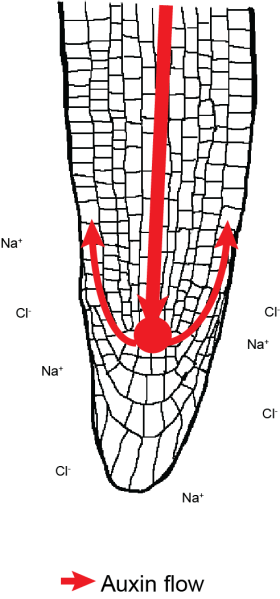
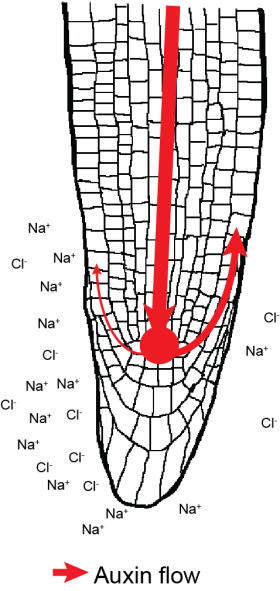
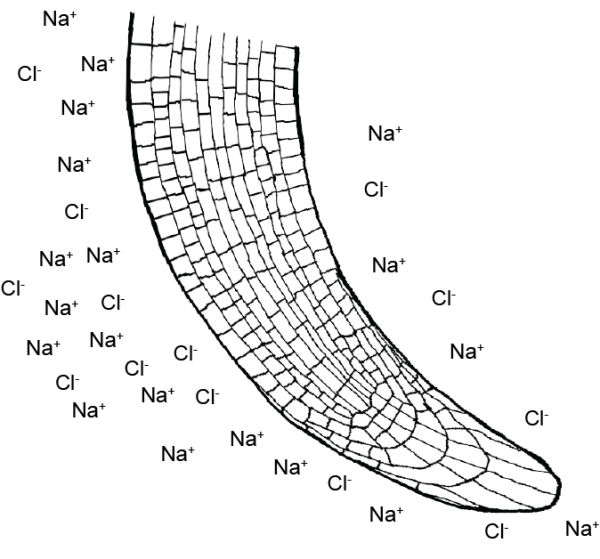
The effects of salt stress on plants can be initially seen as a reduction in growth, with slower expansion of young leaves and slower emergence of lateral buds, resulting in fewer branches and lateral shoots. Later on the senescence of mature leaves can be observed. This later response is due to the toxic effect of Na+ ions. The earlier response is due to the osmotic stress caused by the high concentration of salt around the roots. Although, it would be expected for the roots to be more sensitive to high salt concentrations, the roots actually appear to be less affected. The initial response to salt stress in the roots is a complete stop in growth, but they recover quickly, within an hour for moderate stress to within a day for severe salt stress. While root growth recovers, it does not reaches the same rate as before being affected by salt stress. Furthermore, the root will adjust its growth into the direction where the concentration of salt is the lowest.

As salinity is a common occurrence in soils plants have evolved mechanisms to deal with its consequences. Plants can become more tolerant in three ways, firstly by becoming more tolerant to osmotic stress. When plants have a higher tolerance to osmotic stress they can keep up the rate of leaf growth. However, as a larger leaf area would mean more water loss via the leaves, this would only be beneficial when there is enough water in the soil. A second way to become more tolerant to salt stress is to exclude Na+ from the leaves. In this strategy Na+ would be excluded by the roots so it would not be able to accumulate in toxic concentrations the leaves. A third way to become more tolerant is tissue tolerance. Applying this strategy, Na+ and/or Cl is compartmentalised on cellular or intracellular level. By doing this Na+ or Cl would not be able to build up to toxic concentrations in the cytoplasm. Of course a plant does apply all these strategies to various degrees depending on the species. The effectiveness of these strategies also depend on the level of salt stress, the developmental stage of the plant and other environmental conditions like soil water level and air humidity.

Mangroves in Kannur, India

A good example of a halophyte are mangrove trees which grow in coastal saline or brackish water. They are more tolerant to osmotic stress by actively limiting the amount of water that  they lose through their leaves. Either by restricting the opening of stomata, or by adjusting the orientation of their leaves so they are not exposed to the midday sun. Both strategies limit the water loss through the leaves.  To avoid Na+ building up in the leaves mangroves actively filter salt from the roots, in Red mangroves this results in 90-97% of salt being excluded.  While mangroves filter out a large proportion of the salt at the roots, the salt that does make it up the shoot is compartmentalised. Either in old ‘sacrificial’ leaves which are shed when the concentration becomes to high. Stored in vacuoles as done by red mangroves. Or secreted through salt glands at the base of the leave, which is done by white or grey mangroves.

References
  • Munns and Tester, 2008,  Mechanisms of Salinity Tolerance, Annual Review of Plant Biology 59:651-681

  • Julkowaska and Testerink, 2015, Tuning plant signalling and growth to survive salt, Trends in Plant Science 20:219-229

  • Galvan-Ampudia et al., 2013, Halotropism is a response of plant roots to avoid a saline environment, Current Biology 23:2044-205

  • “Morphological and Physiological Adaptations: Florida mangrove website”. Nhmi.org.