
Bending due to gravity
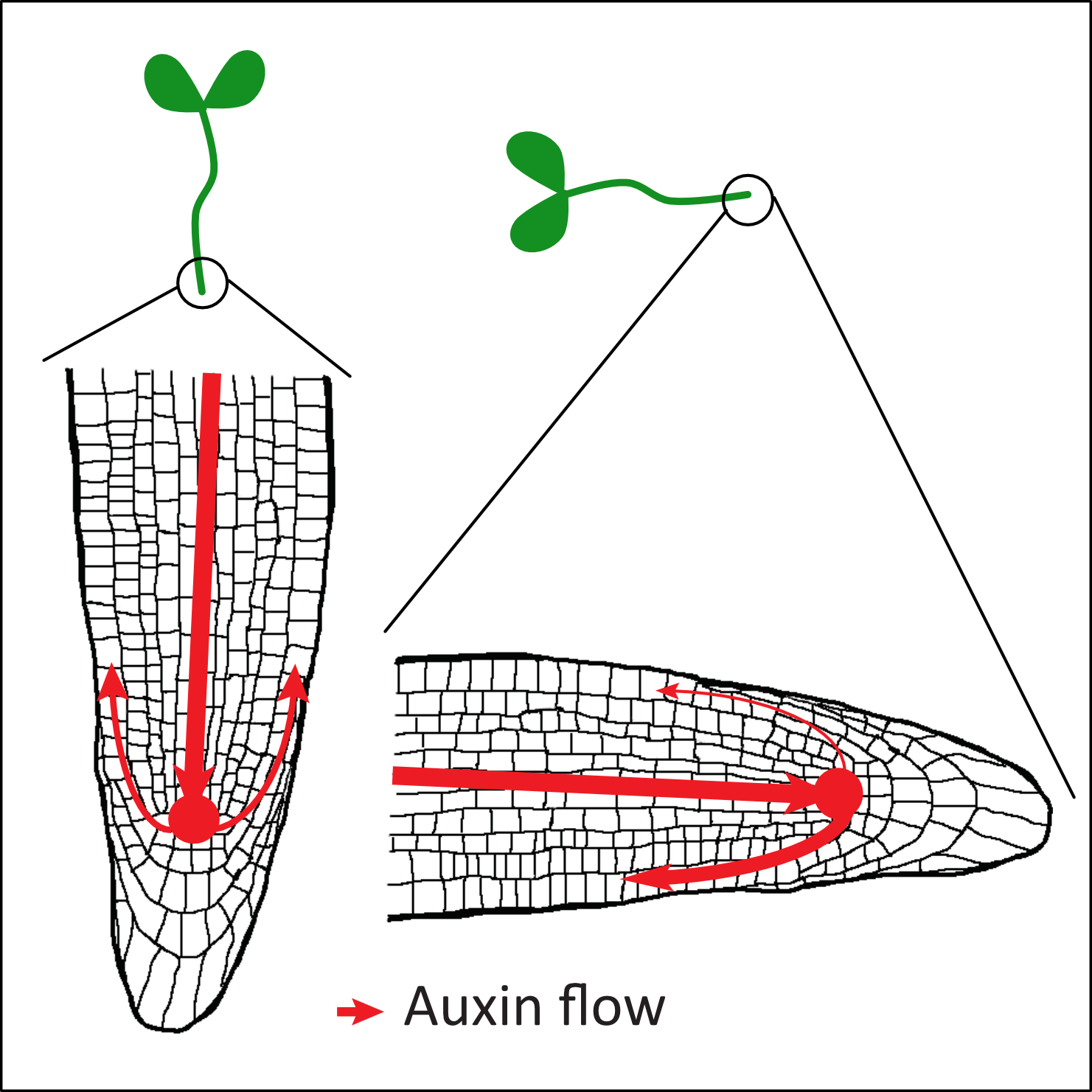
Place a plant on its side and its roots and shoots quickly grow down and up again. The plant sensed that the direction of gravity changed and adjusted its growth accordingly. But how plants regulate this temporary adjustment was not exactly known. Now a group of international researchers show that one part of the answer is the temporarily activating the auxin response factor ARF19.
Plant roots generally grow downwards. But sometimes they have to change direction like when they come across a rock. Then, and on the occasions when researchers turn plants sideways, plants sense a change in gravity. They respond to this new reality, and soon the roots bend and grow downwards again.
Before we can go into how plants manage this, first some basic root growth. Roots grow from growth centres at the tip of the root. From here small compact newly formed cells are added. Also here, there is a maximum of the plant hormone auxin, which from the tip flows back up the root, while gradually decreasing. This last bit is important as high auxin levels stops the newly forming cells from stretching themselves too soon. So when auxin levels are low enough, the cells start to stretch or elongate themselves.
Responding to more auxin
Now when roots perceive a change in gravity, they adjust this auxin flow back up the roots. They do this in such a way that the cells on the side of the root that is lower more auxin moves back up the root than the cells on the opposite side of the root. This results in two things. Firstly, the cells on the lower side of the root no longer stretch themselves. Secondly, the cells on the upper side of the root stretch themselves even more. Together this causes the root to bend.
Now the question that the researchers had was what happens between sensing more auxin and preventing the cells to stretch. A previous study showed that two auxin response factors ARF7 and ARF19 are needed for this. Under normal circumstances the activity of ARFs is repressed by so-called Aux/AAI proteins. Those Aux/AAI proteins get broken down when auxin levels increase, allowing ARFs to do their job of activating genes. In the case of responding to gravity, this would be genes related to the regulation of cell stretching.
Knowing this, you would expect that ARF genes are always active in the cell types they do their job in, so that upon auxin sensing they can directly start. But what the researchers found when looking at ARF gene activity after placing the plant sideways, was that ARF19 gene was actually activated. This activation was corresponding to the increased auxin levels in the lower root cells.
Temporally active
To find out where ARF7 might be needed for, the researchers explored a number of scenarios using a model. The one that matched the best with the observations was the one in which ARF7 activates the ARF19 gene but ARF19 is not activating its own gene. To conform that this is indeed what happens, the researchers looked if ARF7 and ARF19 could bind to the ARF19 promoter regions (this is how they activate genes in general). Finding that ARF7 indeed bound to the ARF19 promoter region, while ARF19 did not.
But then they found one oddity. Although the ARF19 gene requires ARF7 for activation, in absence of ARF7 plants still respond to gravity. So, the researchers did some digging, finding that ARF6 and ARF8 are often involved in auxin regulated processes in the roots. Therefore, they checked if these proteins could also bind to the promoter region of ARF19. Finding that while ARF6 could not, ARF8 could. Explaining how there still could be a response to gravity in the absence of ARF7.
So, upon sensing a change in the direction gravity comes from the plant adjust its auxin flow back up the root. This in turn for the lower laying cells means more auxin and the activation of the ARF19 gene by ARF7 and ARF8, followed by the activation of genes involved in preventing cell from stretching themselves. On the others side of the root the opposite happens, which together allows for the bending of the root. As the ARF19 gene is only temporary active, this allows the plant to quickly return to the normal situation.
Literature
Erfan Ghafouri et al., ARF19 acts as a transient auxin response enhancer during root gravitropism. Cell Reports, 2026, 45 (6) 117555, https://www.cell.com/cell-reports/fulltext/S2211-1247(26)00633-9

