
How light helps plants cope with warmer temperatures
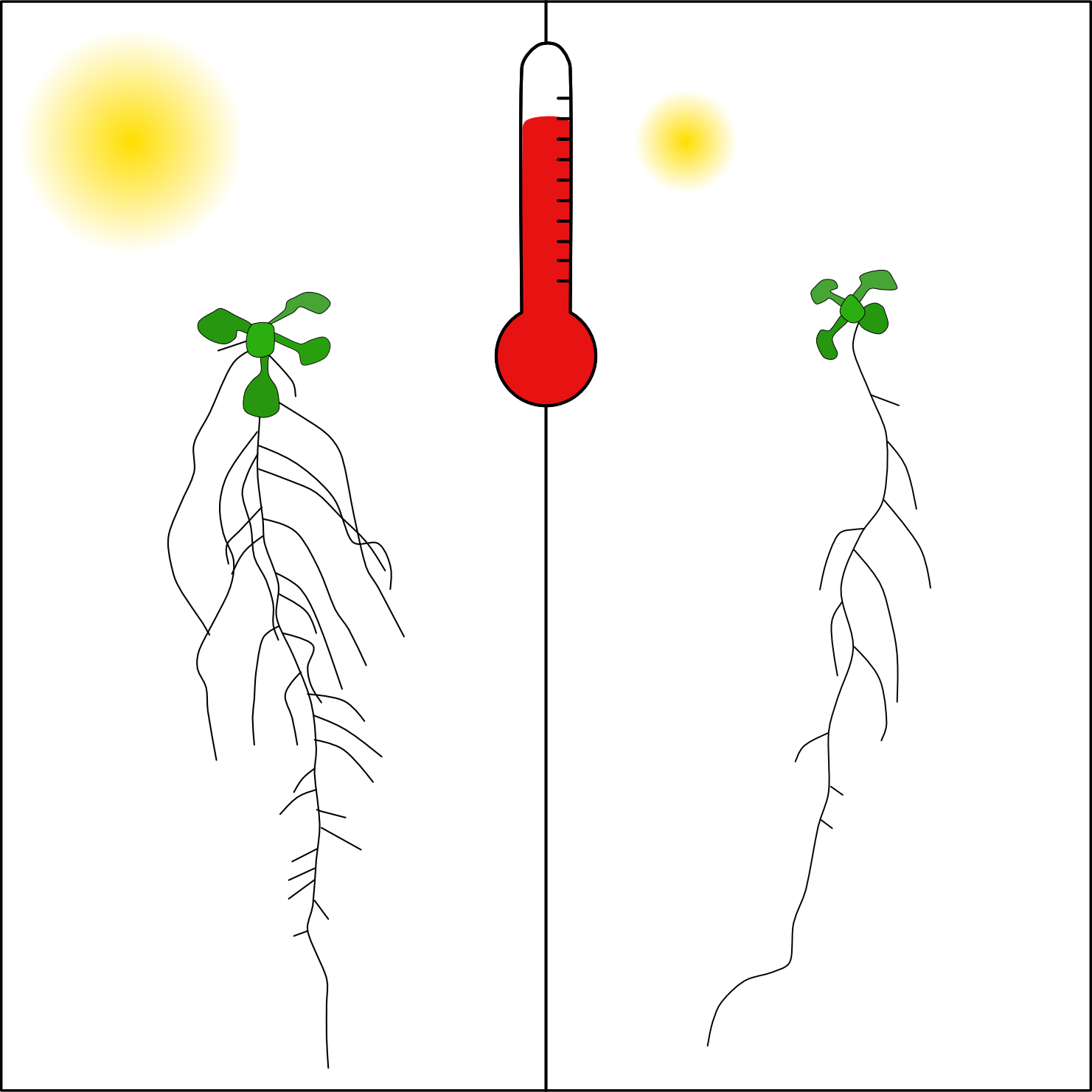
A well-developed root system not only helps plants to anchor themselves, but to access nutrients and water as well. So, knowing what influences root development helps with growing healthy plants. Now a new study by a group of international researchers shows that side root development depends on both the light intensity and the temperature.
Where on the root a root branches of into a side root is determined by two things. First is the site of maximal abundance of the plant hormone auxin. Every six hours one forms in the elongation zone of the root. This will be the site where a future side root is permitted to develop.
At these appointed sites, also called pre-branch sites, the development of side roots is initiated. But only when auxin levels stay high enough at those sites. And warming is one signal, previous research show, that reduce those auxin levels. Which in turn would result in less side roots.
So, when the researchers noted that thale cress (Arabidopsis) plants that were sifted to a warmer temperature still developed the same number of side roots as plants did that weren’t shifted, the researchers new more was going on.
Temperature affects the rhythm
So, the researchers painstakingly followed the auxin levels in the roots with help of a receptor that lights up in the presence of auxin. Finding that in the roots of thale cress plants grown at 21°C auxin levels showed a 24-hour rhythm. But when the plants were shifted to 29°C this rhythm disappeared.
However, as the researchers kept monitoring the plants they noticed that after about three to five days the signal recovered and re-established itself. Allowing the development of side roots to continue.
Now all this was done in growth cabinets with lots of light. Therefore, the next thing the researchers asked was if the light intensity has any influence on this all. By repeating the experiments at lower light intensities, the researchers noticed that the disappearance of the auxin signal at high temperatures did not recover itself when the light intensity was too low (about 10-30% of the high light intensity).
Molecular mechanism
As the plants that were grown in enough light recovered some of their auxin rhythm, the researchers looked at what protein might be responsible for this. Coming out by the auxin oxidising enzymes DAO1 and DAO2. These enzymes effectively take auxin out of action so that it no longer can do its job. So, the researchers looked at what the levels of DAO1 and DAO2 did. Finding that both showed a 24-hour rhythm. And that at higher temperatures there is more DAO1 and DAO2.
But only thale cress plants without DAO1 did not inhibit the development of their lateral roots when they were grown at higher temperature and medium light levels. Plants without DAO2 behaved the same as when DAO1 was there. Suggesting that it is DAO1 is mainly responsible for the decrease of the auxin rhythm at higher temperatures. Although, more research is needed fo find out how exactly.
So, how root development is affected by an increase in temperature depends just as much on the temperature itself as on the above ground light intensity. Showing that for plants the context in which a signal is perceived matters. As such the perception of the same temperature increase can result in a different outcome if the perceived light intensity differs.
Literature
Ren C., Bodendorf J., Pěnčík A., González-Delgado A., Li S., Moreno-Risueno M.A., Wabnik K., Novak O., and Kleine-Vehn J. (2026). A systemic auxin state integrates light and temperature to gate lateral rooting in Arabidopsis. Molecular Plant doi: https://doi.org/10.1016/j.molp.2026.10.022

