How phosphoinositol lipids can have an effect


How phosphoinosotol lipids can have an effect

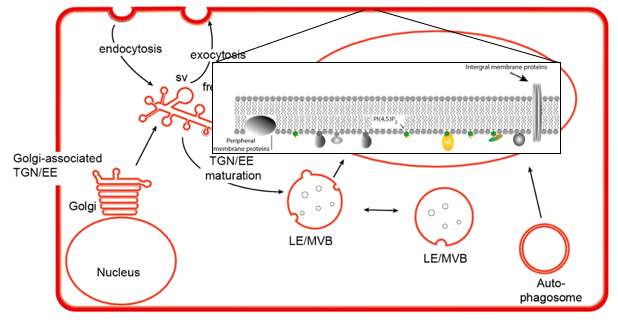
So in the last post I talked about that I am busy with trying to identify phosphoinositol lipids. But did not really say why I would like to know which proteins bind to my phosphoinositol lipid of interest. Phosphoinositol lipids can been seen as markers of the membranes. For example the plasma membrane has the phosphoinositol lipids PI(4)P and PI(4,5)P2. but membranes of the Golgi has only PI(4)P. In this way the cell is able to distinguish between the Golgi and the plasma membrane. With as result that the proteins whose interaction should happen at the plasma membrane are doing their job at the plasma membrane and not at the Golgi membrane. As such phosphoinositol lipids function as signalling molecules. In cells local differences in the abundance of phospholipids have been seen, also their abundance can be affected by external stimuli, for example salt stress increases PI(4,5)P2 levels. Thereby specifying the location and timing of the interactions that take place. Of which the exocyst complex is one.

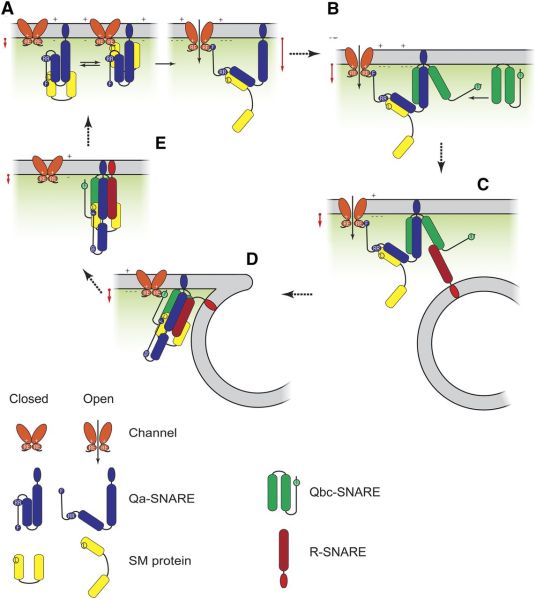
The exocyst complex helps connecting secretory vesicles to the plasma membrane. The secretory pathway can basically divided into five stages, starting with the budding of a vesicle, its transport towards the target membrane, initial attachment of the vesicle to the target membrane, the docking of the vesicle and finally fusion with the membrane. The exocyst complex is involved in the third stage, the initial attachment of the vesicle to the plasma membrane. By doing so it also creates a bigger anchorage point where all the proteins that are needed for successful exocytosis.

The exocyst complex was originally discovered in yeast and is and consist out of eight proteins. Homologues of these eight proteins are present in plants, however as for a lot of plant genes, some have multiple paralogues which can complicate things a bit. Two of the exocyst subunits, Sec3 and EXO70, create contact points with the plasma membrane. Sec3 does this by directly binding to PI(4,5)P2. Although it is known that EXO70 binds to the plasma membrane the specific phosphoinositol lipid it binds to is unknown. Furthermore there are multiple paralogues of EXO70, suggesting they play a role in specificity of the location of binding to the plasma membrane. The binding of the exocyst to the plasma membrane is further stabilised by the binding of Sec10 to the cytoskeleton.

For the binding of the vesicle to the exocyst complex it is less clear how this might be happening. It is known that Sec15 plays a role in binding the vesicle to the exocyst complex. However Sec15 is not binding directly to the vesicle lipids like Sec3 and EXO70 are doing at the plasma membrane. Instead, vesicles use RabE GTPases to bind to the exocyst. These GTPases are attached in the membrane of the vesicle via an lipid binding domain. For binding to the exocyst RabE first binds the SCD complex which in turn bind Sec15. At the same time the SCD complex activates RabE, enabling it to activate PIP5K which phosphorylates PI(4)P to produce PI(4,5)P2. As there are multiple paralogous for RabE, SCD as well as for PIP5K, it is possible they have a role in the specificity of the location of vesicle excretion. However not much is known how exocyst subtypes select the vesicles they bind.

Hopefully this made it a little bit clearer how a signalling lipid located in the plasma membrane can actually have an effect. The next question that everybody will ask of course is will those exocyst complex proteins be among those proteins that bind my phophoinositide lipid in response to salt stress. To be able to make a prediction like that we should look about what we know is happening during salt stress to a cell. The initial response will be a loss of water, due to osmosis, shrinking the cell, as well as taking up Na+ and Cl ions. But at the time of sampling the cell is already trying to make up for this by actively pumping water in and pumping salt out. For this ion channels need to be activated, this can possible go via phosphoinositide lipids. It is also possible that these ion channels are newly deposited at the plasma membrane via exocytosis. Then it is a possibility that EXO70 and Sec3 are among the proteins that are identified as interacting with the phosphoinositide lipids during salt stress. But this is pure speculation based on what we guess is going on at the time of analysis. The only way to find out is actually identifying those proteins that bind my phosphoinositol lipid.

Literature

Saeed et al., Dissecting the plant exocyst, Current Opinion in Plant Biology, 2019, 52: 69-76

Noack and Jaillais, Precision targeting by phosphoinositides: How PIs direct endomembrane trafficking in plants, current Opinion in Plant Biology, 2017, 40:22-23

Mayers at al., SCD1 and SCD2 form a complex that functions with the exocyst and RabE1 in exocytosis and cytokinesis, The Plant Cell, 2017, 29: 2610-2625

Camacho et al., Arabidopsis Rab-E GTPases exhibit a novel interaction with a plasma-membrane phosphatidylinositol-4-phosphate 5-kinase, Journal of Cell Science, 2009, 122: 4383-4392

Work in progress


Work in progress

This last week I have been busy with organising my results and preparing them for a presentation that I gave for some of our department. And although I have made some progress with my project since I started it, the presentation I gave highlighted the lack of useful progress during the last half year or so. I say useful progress on purpose. Of course you always make some progress, if only by figuring out why something did not work. But my last year has been basically that, finding out why something did not work in my protein purification procedure, amend this, just to have something else going wrong.

So what I try to do is purify proteins that bind to a phosphoinositol lipid. These phosphoinositol lipids come in different flavours which have both a specific shape and a charge. This enables proteins that bind those phosphoinositol lipids to discriminate between them. Although, you have proteins that bind depending both shape and charge, specific binders, however, others will bind based on charge only, unspecific binders. In my project we are primarily interested in those specific binders. In order to determine which proteins bind specifically and which unspecifically we like a step in the purification procedure that would allow us to discriminate between them. And it is step that primarily gives me trouble. Sometimes it works, but then at other times it doesn’t. As if having optimised the binding to the phosphoinositol-beads affects the ability to discriminate between specific and unspecific binding proteins.

Different floavours of PIs (2)
Different flavours of phosphoinositols


The good thing that came out of my talk was that when another PI suggested to do the purification without the step to discriminate between specific and unspecific binders, in the end my PI gave in. I now will be faced with the larger task afterwards to weed out the unspecific from the specific binders after having identified the proteins from the purification. But for now I am excited to finally be able to do the big scale purification for the protein identification to get that list of phosphoinositide binders to work with.

New lipid biosensor shines some light on stress response


New lipid biosensor shines some light on stress response

PA (phosphatidic acid) is a membrane lipid, however it is also an important signalling lipid involved in the regulation of important cellular processes. In plants PA has been shown to be involved in the regulation of stomata opening as well as in drought and salt stress. PA can be made through a number of pathways, of which the phospholipase D (PLD)-mediated hydrolysis of phospholipids is one. PA signalling takes place through direct interaction with effector proteins which affects their activity. While it is known that PA shows dynamic changes in response to different stimuli, up to now we have been unable to observed these directly.

In the recent paper of Li et al, they report the development of a new type of biosensor for PA, which enables the measurements of change in concentration and dynamics of bioactive PA. Using this biosensor they were able to show that not only PLD generates bioactive PA in response to ABA, salt and osmotic stress, but that the dynamics with which PA is generated is dependent on the type of stimuli observed. Moreover, they showed that binding of the PA biosensor was pH dependent together with that there is a pH dependent element in plant salt tolerance.

To make this new type of ratiometric PA-biosensor the authors made use of the PA-binding domain of  the protein RHOHD. First they showed that this domain only binds PA and no other lipids. For making the biosensor ratiometric the authors made use of FRET, by placing the PA-binding domain between two fluorescent proteins, with suitable linkers they created a biosensor that upon binding PA had a greater FRET efficiency. This enabled them to calculate the ratio between bound and unbound PA-biosensor. To be able to measure quick changes the authors added a plasma membrane localization signal to the biosensor. Testing the biosensor in Arabidopsis using external application of PA they showed that the biosensor had a quantitative response to PA.

Now they had a ratiometric PA-biosensor the authors wanted to test it with known inducers of PA. First they tested how the response was to externally applied ABA. Using the biosensor they showed that ABA caused an increase in FRET signal, and thus PA, within 200 seconds. As PA can be synthesised via different routes they tested if the enzyme PLD has a role in the production of PA in response of ABA. Using n-butanol to suppress PA production by PLD, they showed that the increase of PA in response to ABA was reduced. The use of a pld mutant line also showed a reduced and delayed increase of PA in response to ABA. Suggesting that PA production in response to ABA is primarily done via PLD.

Next they tested response to salt stress. Upon application of NaCl to the root tip it almost immediately caused an increase in FRET signal, this was most strongly seen in the root tip, but also observed in the differentiation and maturation zone of the root. Again they tested if PA in response to sat stress was made via PLD, by applying n-butanol and using the pld mutant. Showing that indeed PLD is responsible for the production of a large amount of PA in response to salt stress. While the pld mutant shows a reduction and delayed increase of PA in response to salt compared to wild-type, this reduction and delay in response was less than seen for the PA response to ABA in the pld mutant.

As salt stress has both an ionic and an osmotic component, the authors tested also the effect of osmotic stress by application of mannitol. Again upon application of mannitol an increase in FRET signal was observed.  However in the pld mutant the FRET signal in response to mannitol was severely delayed and reduced. With this the authors concluded that while ABA, salt and osmotic stress al resulted in an increase in PA derived from PLD, the dynamics of this PA increase is dependent on the type of stress perceived.

Lastly the authors reasoned that the binding of the biosensor to PA was pH dependent. To test this the authors analysed the binding of the biosensor to PA under neutral (5.8), low (4.5) and high (7.0) pH. Whit this they showed that the binding of the biosensor to PA was reduced when the roots were placed from neutral into low pH solution, and that placing them back at neutral pH solution restored the binding to PA. Moreover, transferring the roots form neutral in to high pH solution resulted in an increase in binding to PA, and placing the roots back at a neutral pH solution reduced the binding to PA to the original levels. Repeating this last analysis in the presence of salt the authors showed that while salt still elicited a PA response, the binding of the biosensor was affected by the pH in which the roots were placed with a stronger signal at a higher pH level, which was reduced when the pH was lowered. Showing that the ability to respond to salt stress has a pH-dependent element.

With this Li et al., not developed an very usefull new ratiometric PA-biosensor, but also shown us what we have been missing in the previous studies of PA response to ABA and salt stress.

When NaCl knocks on plant’s door


When NaCl knocks on plant’s door

When a plant root comes across a patch of soil with a higher amount of salt, one of the first things it does is sending up a wave of Ca2+ signal up to the shoot. Depending of the size of the plant this Ca2+ wave can reach the top within minutes. There it will regulate gene expression and protein activity to prepare the shoot for the osmotic and salt stress. For example activating the expression of genes that encode Na+ channels that will either exclude Na+ from the cell or compartmentalise it.

As plants don’t have a nervous system like animals do, signals between distant part of the plant need to travel from cell to cell, in general this is a relatively slow process. However some signals travel faster than others. Ca2+ are versatile second messengers, and in contrast to some other signalling molecules, Ca2+ has been shown to be able to travel quickly from cell to cell. In general the Ca2+ concentration in the cytoplasm is relatively low, however cells have high levels of Ca2+ stored in storage compartments. Upon a stimulus this stored Ca2+ will be released to increase the cytoplasmic Ca2+ levels which in turn will activate a set of proteins that sent a signal out of the cell that is picked up by neighbouring cells, setting off the whole signalling cascade again.

So what will happen when the root comes across a patch of high saline soil. The first thing it will notice that there is an increase in Na+ ions. These Na+ ions will bind to a negatively charged membrane lipid called glycosyl inositol phosphorylceramide or GIPC for short. The binding of Na+ to GIPC then activates an GIPC-associated Ca2+ channel. Resulting in an influx of Ca2+ ions into the cytosol. One of the things these newly entered Ca2+ ions will trigger is the signalling cascade triggering the Ca2+ wave towards distal parts of the plant, telling the rest of the plant to prepare for an influx of Na+ and Cl ions.

The best model to date indicates that to create this Ca2+ wave the plant makes use of H2O2 which can feely diffuse between cells. Upon entering the cell Ca2+ is detected by CPKs and CBL-CIPKs which in turn phosphorylate a plasma membrane bound RBOH NADPH oxidase. The phosphorylation of RBOH results in its activation and the production of H2O2, which will then diffuse to the neighbouring cells. There it will trigger Ca2+ release from the vacuole by either directly or indirectly activating the vacuolar Two-Pore Channel 1 or TPC1. This newly released Ca2+ will again result in the activation of RBOH. Resulting in a self-sustaining cell-to cell-propagating long-distance Ca2+ wave.

ca2+ wave corrected
Model of the Ca2+ wave signaling cascade, showing that it keeps going once it started.

While researchers are still trying to get the details right and verify this model beyond any doubt, it fits nicely with our current evidence. Part of the difficulty is that plants have many CPKs, CBL-CIPKs and RBOHs which in addition forming the Ca2+ wave are involved in many Ca2+ and ROS signalling pathways. making deciphering their interactions and effects complex and time consuming.

References

Jiang et al., Nature, 2019

Steinhorst and Kudla, Nature 2019

Steinhorst and Kudla, Current opinion in plant biology, 2014, 22:14-21

Choi et al., PNAS, 2014 111:6497-6502

Stephan and Schroeder, PNAS, 2014, 111:6126-6127

Koster et al., Plant Biology, 2019, 21:39-48