Salt loving bacteria help plants in salty soils


Salt loving bacteria help plants in salty soils
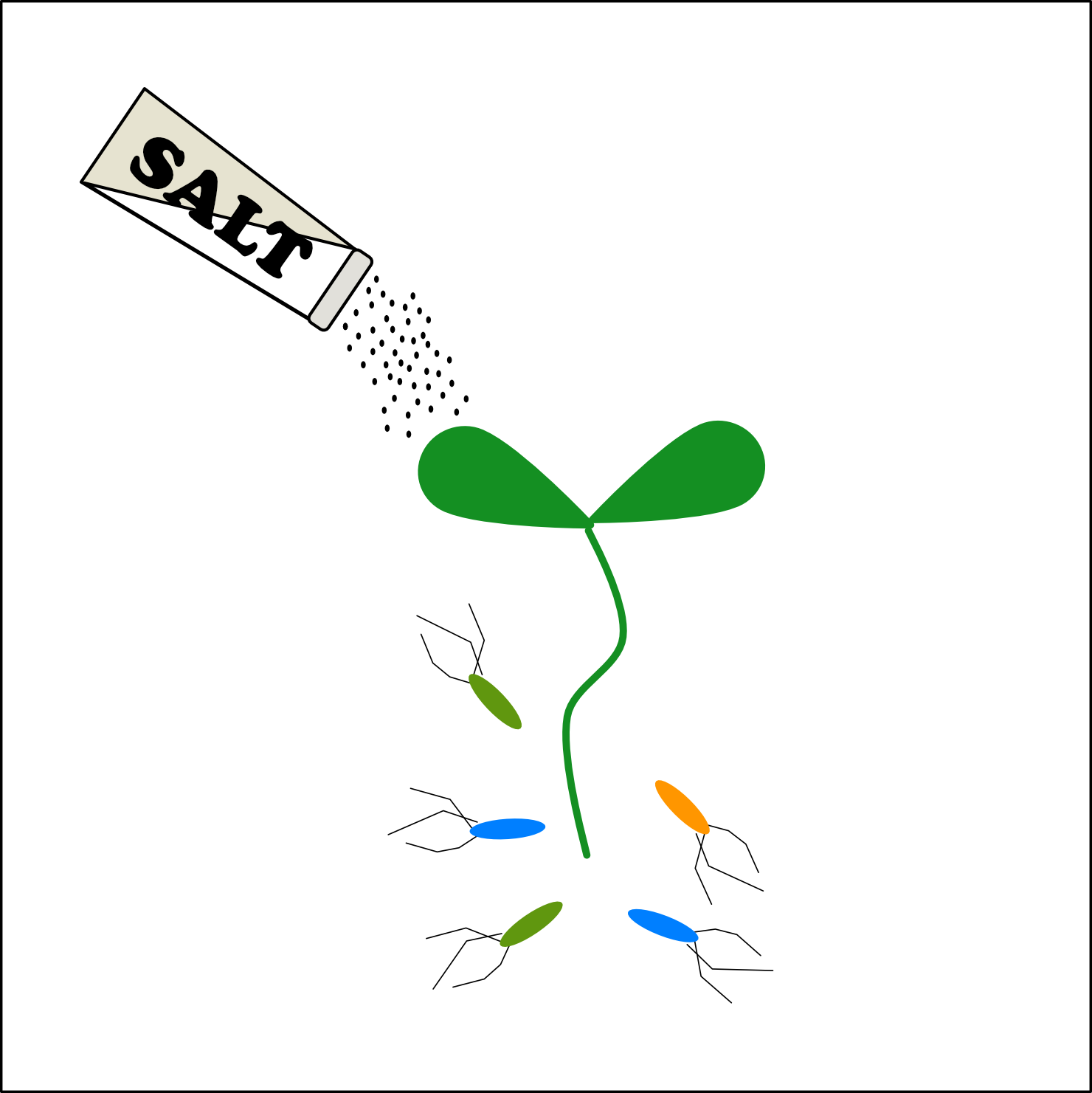
Crops growing on salty soil do less well than their on none salty soil growing counterparts. And this is a problem, as salinity affects huge swatches of soil all over the world. Now a group of Indian researchers decided to find out if salt loving bacteria could help plants grow on salty soils.

One way of making crops more salt resistance is to breed for this. Time and time again selecting for traits that improve a plant’s survival in salty soils. As you can imagen, this is a time-consuming task. And as such can take many years.

Alternatively, you can rein in the help of microbes. It is known that microorganisms can produce growth promoting compounds, and in this way can act as biofertilizers. But just as plants have their preferred environment, microbes do too. So, for salty soils the challenge is to find microorganisms that do both.

Finding salt loving bacteria

The Indian researchers were up for that challenge. They travelled to the Marakkanam salt pan on the east coast of India and took some soils samples. Back in their lab they isolated the bacteria present and selected six unique looking bacteria strains for further characterization. Genetic analysis confirmed that they were dealing with six different bacteria species.

All strains grew happily on 15% salt containing medium. But more importantly, all strains were producing the growth hormone auxin. Some of the strains could produce ammonium, or solubilize potassium, both important minerals that plants obtain via the soil.

The next question was, is this enough to help plants grow better in salty soils. For this the researchers grew spinach in salty soil, with and without the isolated bacteria. As a control the researchers had also spinach plants growing on normal soil, and on salty soil with a commercial biofertilizer.

Spinach grows better with salt loving bacteria

The first thing the researchers noticed was that plants, growing with one of the salt loving bacteria, grew much better on salty soils than any of the controls. They grew even better than the control on normal soils.

Further analysis, suggest that this most likely is due to the fact that the salt loving bacteria also provide the plants with osmolytes. These compounds help the plants to keep the cell turgor, or pressure, and protein stability in salty conditions.

This analysis is just a first step towards using salt loving bacteria as biofertilizers for crops growing in salty soils. Like the authors say, field experiments are needed to validate these preliminary findings are just as much needed as further analysis about how these salt loving bacteria stimulate plant growth in salty environments.

Literature

Raphael, D., Parthasarathi, T. Enhancing salinity tolerance and growth of Spinacia oleracea L. using halophilic plant growth-promoting bacteria. Sci Rep (2026). https://doi.org/10.1038/s41598-025-34907-2


Thanks for reading.
If you like what you read, support me with on of the following actions

Follow me on LinkedIn or BlueSky
Share it with a friend or co-worker
Singing up to my newsletter so my next blog lands directly in your inbox

Zout liefhebbende bacteriën helpen planten in zilte grond


Zout liefhebbende bacteriën helpen planten in zilte grond

Gewassen groeiend op zilte grond doen het minder goed dan hun op normale grond groeiend broers en zussen. En dit is een probleem, omdat over de wereld grote delen van de grond verzilt is. Nu besloten een groep van Indiaanse onderzoekers uit te vinden of zout liefhebbende bacteriën planten kunnen helpen om op zilte grond te groeien.

Een manier om gewassen geschikt te maken om op zilte grond te groeien is door erop te selecteren. Door keer op keer te selecteren op eigenschappen die de overleving van de plant op zilte gronden vergroten. Zoals je kan bedenken, dit is een tijdrovend proces. Een die vele jaren in beslag kan nemen.

Als alternatief kan je de hulp in roepen van microben. Het is bekend dat micro-organismen groeibevorderende stoffen kunnen produceren, en op deze manier kunnen werken als bio-bemesting. Maar net als planten hun voorkeurs omgeving hebben, hebben microben dat ook. Dus voor zilte gronden is de uitdaging om micro-organismen te vinden die beide doen.

Zout liefhebbende bacteriën vinden

De Indiaanse onderzoekers waren wel op voor die uitdaging. Ze reisde af naar de Marakkanam zout vlakte aan de oostkust van India, en namen wat grondmonsters. Terug in het lab isoleerde de onderzoekers de aanwezige bacteriën, en selecteerde zes uniek uitziende bacterie stammen voor verdere bestudering. Genetische analyse bevestigde dat het om zes verschillende soorten ging.

Alle stammen groeide prima op 15% zout bevattend medium. Maar belangrijker nog, alle stammen produceerde het groeibevorderende hormoon auxine. Sommige van de stammen produceerde ook ammonium, of loste kalium op, beide belangrijke mineralen die planten uit de grond opnemen.

De volgende vraag was, is dit genoeg om planten beter in zilte gronden te laten groeien. Om dat te beantwoorden groeide de onderzoekers spinazie op zilte grond zowel zonder als met de geïsoleerde bacteriën. Als controle groeide de onderzoekers ook planten in normale grond, en op zilte grond met een commerciële bio-bemesting.

Spinazie planten groeien beter met zout liefhebbende bacteriën

Het eerste wat de onderzoekers op viel was dat de planten groeiende op de zilte grond met een van de zout liefhebbende bacterie stammen het veel beter deden dan alle controle planten. Ze groeide zelfs beter dan de controle in normale grond.

Verdere bestudering suggereert dat dit hoogstwaarschijnlijk komt omdat zout liefhebbende bacteriën de planten van osmolieten voorzien. Deze stoffen helpen planten met het behouden van de juiste cel-turgor en eiwitstabiliteit in zilte omstandigheden.

Deze analyse is nog maar de eerste stap naar het gebruik van zout liefhebbende bacteriën als bio-bemesting voor gewassen groeiend op zilte grond. Zoals de auteurs benoemen zijn veld proeven nodig om deze eerste bevindingen te valideren. Net als verdere analyse naar hoe deze zout liefhebbende bacteriën planten groei in zoute omgevingen stimuleren.

Literatuur

Raphael, D., Parthasarathi, T. Enhancing salinity tolerance and growth of Spinacia oleracea L. using halophilic plant growth-promoting bacteria. Sci Rep (2026). https://doi.org/10.1038/s41598-025-34907-2


Bedankt voor het lezen
Vond je het interessant, overweeg dan een van de volgende acties

Volg me op LinkedIn of BlueSky
Stuur het door aan een vriend of collega

Abonnneer je op m’n nieuwsletter zodat de volgende automatisch in je inbox verschijnt.

Sensing temperature


Sensing temperature

Plants sense temperature, but whether this is the actual temperature, or a perceived difference in temperature, that’s what the scientists are not sure about. Now a group of Japanese scientists think they have the answer, at least for the liverwort Marchantia polymorpha.

Temperature sensing is important to avoid cold-related damage. For example, moving the chloroplasts away from the light-irradiated area of the cell to suppress photoinhibition. Chloroplast movement is regulated by the blue light photoreceptor kinase called phototropin or phot for short. Phot likes blue light and gets excited when it detects it, moving the chloroplast closer. However, phot does not like the cold so much, then it moves the chloroplasts away from the light.

To find out if phot is directly sensing the temperature or only a difference in temperature, the researchers designed two experiments, one in which they lowered the temperature by a 5°C difference, and another in which they lowered the temperature by 15°C. But there was a catch in the first experiment the absolute temperature was lower than in the second experiment.

Directly sensing the temperature

The researchers noticed for the first experiment that the chloroplasts moved away from the light. In the second experiment, where the temperature difference was bigger, but the lowest temperature was higher than in the first experiment (12°C in the second vs 5°C in the first experiment) the researchers did not see any movement of the chloroplasts. Suggesting that the plants sense the actual temperature.

To confirm that it was indeed phot that was sensing the temperature, the researchers modified phot so that it became cold insensitive, then even at 5°C the chloroplasts stayed in the light. But only by low levels of blue light, when the researchers increased the blue light intensity, then these chloroplasts with modified phot did move out of the light when it got cold.

A little phosphorylation

To find out how phot manages the sensing of the temperature, the researchers looked at a feature that phot uses to regulate its activity, autophosphorylation. This autophosphorylation takes place randomly at one or multiple spots on the protein. The researchers noticed that how lower the temperature, the more phot is phosphorylated.

But the type of autophosphorylation decides if the chloroplasts are actually moving out of the light. Up to a point the phot protein can autophosphorylate itself, but after that it needs a sister phot protein to do the autophosphorylation for it. As if it needs someone else to find an empty spot. It is only at this point that the chloroplasts start moving out of the light.

Showing both that the level of phosphorylation is a measure of the temperature and that the way of phosphorylation an indication if more action is required.

Literature

Noguchi, M., Fukushima, T., Wakasugi, S. et al. Phototropin monitors actual temperature, not temperature difference, to regulate temperature-dependent chloroplast movement via cistrans autophosphorylation mode switching in Marchantia polymorpha. Planta 263, 55 (2026). https://doi.org/10.1007/s00425-026-04923-1


Thanks for reading.
If you like what you read, support me with on of the following actions

Follow me on LinkedIn or BlueSky
Share it with a friend or co-worker
Singing up to my newsletter so my next blog lands directly in your inbox

Temperatuur waarnemen


Temperatuur waarnemen

Planten nemen de temperatuur waar, maar of dit de eigenlijke temperatuur is of het waargenomen verschil in temperatuur, dat weten wetenschappers niet echt. Nu denkt een groep van Japanse wetenschappers het antwoord te hebben, tenminste voor de levermos Marchantia polymorpha.

Temperatuur waarneming is belangrijk om kou-gerelateerde beschadiging te voorkomen. Bijvoorbeeld door de bladgroenkorrels uit het licht beschenen gedeelte van de cel te verplaatsen om foto-inhibitie te onderdrukken. Het bewegen van bladgroenkorrels wordt gereguleerd door een blauwe-licht receptor kinase genaamd phototropin, of phot in het kort. Phot houdt van blauw licht, het raakt daar helemaal opgewonden van en verplaatst de bladgroenkorrels dichter bij het licht. Maar phot houdt niet echt van de kou, dan verplaatst het de bladgroenkorrels weg van het licht.

Om uit te zoeken of phot de temperatuur direct waarneemt, of alleen een verschil in temperatuur, ontwierpen de onderzoekers twee experimenten. In de eerste verlaagde de onderzoekers de temperatuur maar 5°C, en in de tweede met 15°C. Maar er was een twist, in het eerste experiment was de laagste temperatuur lager dan in het tweede experiment.

Direct de temperatuur waarnemen

De onderzoekers zagen dat bij het eerste experiment de bladgroenkorrels weg van het licht bewogen. Maar in het tweede experiment, waar het temperatuur groter was, maar met de laagste temperatuur hoger dan in het eerste experiment (12°C in de tweede vs 5°C in het eerste experiment) zagen de onderzoekers geen beweging van de bladgroenkorrels. Dit suggereert dat planten de eigenlijke temperatuur waarnemen.

Om te bevestigen dat het inderdaad phot was die de temperatuur waarnam, veranderde de onderzoekers phot zo dat deze kou-ongevoelig werd, waarbij de bladgroenkorrels zelf bij 5°C nog in het licht bleven. Maar alleen bij een lage intensiteit van blauw licht. Verhoogde de onderzoekers de intensiteit van blauw licht, dan verplaatste ook deze bladgroenkorrels zich uit het licht wanneer het koud werd.

Een beetje fosforylatie

Om uit te vinden hoe phot de temperatuur waarneemt keken de onderzoekers naar de eigenschap van phot om zichzelf te fosforyleren. Deze fosforylering gebeurt op willekeurig op een of meerder plaatsen op het phot eiwit. Het viel de onderzoekers op dat naar mate de temperatuur af nam de fosforylatie op phot toenam.

Maar het type van fosforylatie bleek te beslissen of de bladgroenkorrels ook daadwerkelijk uit het licht bewogen. Tot op een zeker punt lukt het phot om zichzelf te fosforyleren, daarna heeft het hulp nodig van een zuster phot eiwit om de fosforylatie te doen. Alsof het iemand nodig heeft om een lege plek te vinden. En het is op dit moment dat de bladgroenkorrels uit het licht beginnen te bewegen.

Dit onderzoek laat zowel zien dat het niveau van fosforylatie op phot een maat voor de temperatuur is en dat de manier van fosforyleren een indicatie is dat meer actie nodig is.

Literatuur

Noguchi, M., Fukushima, T., Wakasugi, S. et al. Phototropin monitors actual temperature, not temperature difference, to regulate temperature-dependent chloroplast movement via cistrans autophosphorylation mode switching in Marchantia polymorpha. Planta 263, 55 (2026). https://doi.org/10.1007/s00425-026-04923-1


Bedankt voor het lezen
Vond je het interessant, overweeg dan een van de volgende acties

Volg me op LinkedIn of BlueSky
Stuur het door aan een vriend of collega

Abonnneer je op m’n nieuwsletter zodat de volgende automatisch in je inbox verschijnt.