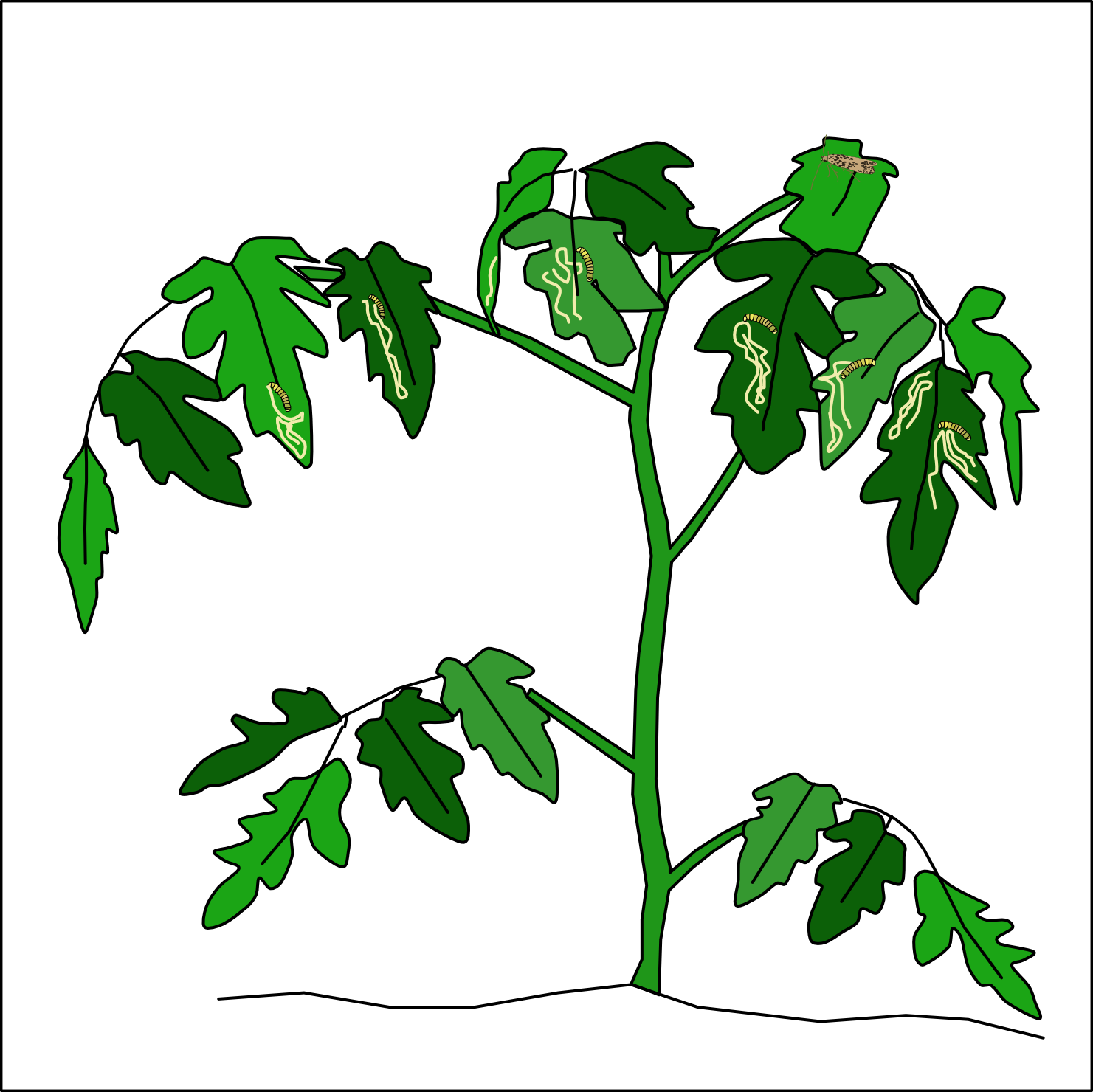
Herbivory insects manage to influence the stomata opening of the plant they feed on. Most do this to keep the stomata closed so they minimise the release of volatile organic compounds. These scent molecules are after all responsible for attracting the enemies; predatory insects. But the tomato leafminer (Phthorimaea absoluta) does the opposite. It forces the stomata open and uses the released benzaldehyde as a cue that it is best to lay its eggs on an uninfested plant a new study found.
It all started out with a question of why this tomato pests became so successful. It not only manages to escape predators that might keep it in check but also expands its range where it can be found. To find out how this insect manged this feat, the researchers of this latest study started with studying it. Finding that its larvae do quite well on already infested plants. However, despite larvae success on infested plants, egg laying females preferred to find an uninfested plant to lay their eggs.
This behaviour of the tomato leafminer appears to be an exception. The researchers found that egg laying females of other common tomato pests preferred already infested plants to lay their eggs on.
Scent signs
Subsequent analysis of the volatiles the infested plants released showed that those released after a tomato leafminer infestation were different from those released by plants infested with other herbivory insects. Suggesting that the key to the leafminer’s behaviour might be in the scent bouquet that is released.
Comparing this scent bouquet from infested and uninfested plants identified multiple potential signalling compounds. But analysing their effect on egg laying leafminer females reduced them to two compounds: Benzaldehyde and (Z)-3-hexenol. Of those, only benzaldehyde turned out to affect the egg laying female leafminers in the more nature realistic setting of a wind tunnel.
Having identified the volatile compound that influences the insect behaviour, next up was to identify what caused the plant to release benzaldehyde in the first place. Surprisingly this was not due to making more of it. Looking in more detail to the genes whose activity is affected by the leafminer infestation the researchers found that the activity of seven stomata related genes were different compared to the uninfested controls. One of these, IQM1, is encoding a protein known to influence stomata opening.
Open stomata
To confirm if stomata opening is indeed specifically affected by the tomato leafminer infestation, the researchers checked the stomata opening of plants infested with this and other herbivory insects. However, in contrast to the tomato leafminer, those other analysed herbivory insects did not cause stomata to open.
To study the effect of this forced stomata opening, the researchers created tomato plants without a functioning IQM1 gene. Those plants grew normal. But during a tomato leafminer infestation they did not open their stomata like tomato plants with a functioning IQM1 gene. With as result; the egg laying adult tomato leafminers did not go in search for an uninfested plant. They were laying their eggs on the infested one. This caused the food supply of the larvae to exhaust quicker and the death of the larvae. Resulting in a decrease in population growth.
So, the tomato leafminer learned to recognise the release of benzaldehyde by its host plant as a sign to move to an uninfested one. Preventing larvae dead by exhausted plants. It appears that it even manipulates its unwilling host to release this sign. Which molecules in the insect saliva are responsible for this manipulation however still needs to be found out.
Literature
L. Chen, X. Li, Y. Wang, et al. Herbivory-Induced Stomatal Opening Triggers the Dispersal of an Invasive Insect Herbivore. Advanced Science (2026): e77207. https://doi.org/10.1002/advs.77207
Thanks for reading. If you like what you read, support me with on of the following actions
Plantenetende insecten manipuleren de huidmondjes van de plant waarmee ze zich voeden. De meeste doen dat om ze gesloten te houden om zo de uitstoot van vluchtige stoffen te minimaliseren. Deze geurstoffen lokken tenslotte de vijand; jagende insecten. Maar een nieuwe studie laat zien dat de tomatenmineermot (Phthorimaea absoluta) het tegenovergestelde doet. Deze forceert de huidmondjes open en gebruikt de uitgestoten benzaldehyde als een teken dat het beter is om z’n eieren op een nog niet geïnfesteerde plant te leggen.
Het begon allemaal met de vraag waarom deze tomaten plaag zo succesvol is. Niet alleen krijgt deze mot het voor elkaar om uit de klauwen van jagende insecten te blijven, het vergoot ook z’n leefgebied. Om uit te zoeken hoe dit insect dit voor elkaar krijgt besloten de onderzoekers van deze nieuwe studie het insect beter te bestuderen. Hierbij zagen ze dat de larven het goed doen op geïnfesteerde planten. Maar, het viel op dat ondanks dit succes, de eieren leggende vrouwelijke motten de voorkeur hadden om niet geïnfesteerde planten te vinden voor het leggen van hun eieren.
Dit gedrag van de tomatenmineermot blijkt een uitzondering. De onderzoekers zagen dat ei-leggende vrouwtjes van andere veelvoorkomende tomaten plagen de voorkeur aan geven om hun eieren juist op al geïnfesteerde planten te leggen.
Geur signalen
Daaropvolgende analyse van de uitgestoten geurmoleculen van de geïnfesteerde planten liet zien dat het geurboeket van planten geïnfesteerd met de tomatenmineermot anders was dan dat van planten geïnfesteerde met andere plantenetende insecten. Dit suggereert dat de sleutel naar het gedrag van de tomatenmineermot bij het uitgestoten geurboeket ligt.
Vergelijking van het geurboeket van geïnfesteerde en niet geïnfesteerde planten identificeerde verschillende potentiële signaal stoffen. Door het effect op de eierlegende vrouwtjes te bestuderen brachten de onderzoekers dit terug tot twee moleculen: Benzaldehyde and (Z)-3-hexenol. Hiervan bleek alleen benzaldehyde een effect te hebben op de eierleggende vrouwtjes van de tomatenmineermot in een meer natuur realistische setting van een windtunnel.
Het molecuul dat het insecten gedrag beïnvloed geïdentificeerd hebbende, was de volgende taak het identificeren van waarom de plant benzaldehyde uitstoot, Verrassend genoeg niet vanwege opgevoerde benzaldehyde productie. Maar toen de onderzoekers keken naar de genen waarvan de activiteit beïnvloed wordt door tomatenminuurmot plaag zagen ze dat de activiteit van zeven huidmondjes gerelateerde genen anders was vergeleken met de niet geïnfesteerde controle planten. Een daarvan, IQM1, was bekend dat dat deze de opening van de huidmondjes beïnvloed.
Open huidmondjes
Om te bevestigen dat het openen van de huidmondjes inderdaad veranderd door een tomatenmineermot plaag, bestudeerde de onderzoekers het openen van de huidmondjes tijdens een plaag van deze en andere plantenetende insecten. Maar, in tegenstelling tot de tomatenmineermot deed een plaag met andere plantenetende insecten de huidmondjes niet openen.
Om het effect van deze geforceerde stomata opening te bestuderen, maakte de onderzoekers tomatenplanten zonder een functionerend IQM1 gen. Deze planten groeide normaal. Maar tijdens een tomatenmineermot plaag opende ze niet hun huidmondjes wat de tomatenplanten met een functionerend IQM1 gen wel deden. Met als resultaat de eierleggende volwassen tomatenmineermot niet opzoek gingen naar een niet geïnfesteerde plant. Ze legde hun eieren op de geïnfesteerde plant. Waardoor de voedselvoorraad van de larven sneller uitputte en de larven doodgingen. Met een afname van populatie groei als gevolg.
Dus, de tomatenmineermot heeft geleerd om de afgifte van benzyaldehyde door z’n gastheer plant te herkennen als een signaal om te verkassen naar een niet geïnfesteerde plant. Zo voorkomend dat hun larven doodgaan door voedseltekort. Welke moleculen in het speeksel van de insecten verantwoordelijk zijn voor deze manipulatie is nog niet bekend.
Literatuur
L. Chen, X. Li, Y. Wang, et al. Herbivory-Induced Stomatal Opening Triggers the Dispersal of an Invasive Insect Herbivore. Advanced Science (2026): e77207. https://doi.org/10.1002/advs.77207
Bedankt voor het lezen Vond je het interessant, overweeg dan een van de volgende acties
Volg me op LinkedIn of BlueSky Stuur het door aan een vriend of collega Abonnneer je op m’n nieuwsletter zodat de volgende automatisch in je inbox verschijnt.
Last year my mum got two chili pepper plants, planted them right next to each other. Then one day she noticed that from one plant most of its leaves where gone, chomped up by some hungry insect. A caterpillar or a hungry slug. She did not know. But she did notice that the other chili pepper plant, the one standing right next to it, was unharmed, as if it just wasn’t that tasty as its almost devoured neighbour.
So, what happened here? Did the attacked plant ‘warn’ its neighbour. Do plants really talk among themselves or is this all just chemistry with a bit of humanising sauce put in the mix.
What is communication
But first what do we mean with plants talking. Talking among humans seems pretty clear. Someone says something, whether this is by speech, written word, or sometimes even using images, to get a message across to which their audience can reply or act. There is some form of intent behind the message that is conveyed. Someone just muttering to themselves is not seen as talking in a communicative sense.
So how does that translate to plants. The simplest definition can be that one plant produces a signal and another organism, plant or otherwise, acts on it. It changes its behaviour, like the chili pepper plant, who, upon sensing that its neighbour was being eaten, produced some compounds that made its leaves less tasty.
Obviously, plants don’t speak. Neither can those signals plants produce for communication be translated into the speech-like communication we have. For talking, plants use molecules which they kind of let loose in a ‘noisy smell-based groups chat’. But that is how a human would describe it to other humans so they can get a feel for the world plants live in.
It is just as if we can’t help ourselves but to make plants appear a little bit more human when we talk about them. We project on them human capabilities. Which is just the reason why scientists are hesitant to use terms like ‘language’, ‘pain’, and ‘intelligence’ when talking about plants.
Writing this makes me remember my PhD supervisor who reprimanded me for saying that cells ‘decided’ something. He was completely right on this of course. But by taking the emotion out of the message, the message gets not only clearer but also less relatable.
Now we have that out of the way, I tell you the real non-humanise story of talking plants. Because talking they do, they can be real chatterboxes. Oke that was the last of the human metaphors, here we go.
Attacked chili peppers
So, what happened to these two chilli pepper plants between the moment the first one got munched on and the second one became unpalatable. The moment an insect starts eating or sucking plant sap it creates a breach in one or more plant cells. This is sensed by one of the many sensors present in the cell membrane. Plants have also learned to recognise specific molecules present in insect saliva. Detection of either one or both of them results in the sounding of the alarm.
You can visualize this sounding of the alarm as a current moving from cell to cell. From the wound side it is spreading throughout the whole plant. Each cell the current passes gets to work to startup their defence program, consisting among others of producing volatile organic compounds, a.k.a. scent molecules.
These scent molecules are small molecules that can become airborne and travel through the air. When we smell freshly cut grass or crushed mint leaves, we smell a mixture of released volatile organic compounds. Plants use them for communication.
Wounded chili pepper plants emit volatile compounds (in orange) which disperse and reach neighbouring plants and attract predatory insects.
The scents that a plant releases after an herbivore attack can be grouped into two groups. Green leave volatiles, consisting of six carbon alcohols, sesquiterpenes and homoterpenes, are the first, within seconds after the damage they get released. Their fast production is due to the plant storing the precursors of those green leave volatiles in their cell membranes. But it doesn’t stop there. After several hours the plant releases a second salvo of scents. This time consisting of terpenoids and aromatic compounds.
Neighbouring plants
These scents, both the first and second round, neighbouring plants pick up. The scent molecules drift via pores, stomata, into their leaves. There, like in our nose, leaf cells are full of receptors that can pick up those scent molecules. Although, here I have to be honest, most of those receptors have not been identified so far, partly because they in no-way resemble the receptors we have in our nose. But researchers know that there must be receptors of some sort because what happens next.
Only when plants perceive the volatile organic compounds attacked plants release, do they put up their own defences. So, upon perceiving the stress signal from its neighbour that is being eaten, the non-attacked chili pepper plant in my mum’s garden sounds its own alarm, likewise by sending a current through the plant.
But unlike its neighbour that is being eaten, the non-harmed plant doesn’t go all out yet. They ready themselves, a process scientists call priming, so that when herbivores show up, they can attack twice as strong.
This priming involves converting the molecules in these scent bouquets from their attacked neighbours into non-volatile toxins and nasty tasting molecules that stop the herbivory insects from wanting to eat more of that particular leaf. Primed plants also produce their own toxic and nasty tasting molecules as well as enzymes that inhibit the insect’s digestion of plant material.
The last thing that primed plants do, is producing extra floral nectar to attract predatory insects. These insects lay eggs in herbivory insects, hunt them for their young, or eat the herbivory insects themselves, but predatory insects also feed on the extra floral nectar.
What is in it for the wounded plants
Now you might be wondering are those wounded plants just releasing those scents to warn their neighbours or is there something in it for them too.
There is, quite a bit actually. Remember how those perceptions of the stress scents triggered the defence response in neighbouring plants? It does the same in the distant far from the wound site located tissues of the attacked plant. Volatile molecules reach those sites faster than the current, that is initiated upon perception of herbivory, can.
But those released scents also help to repel, deterrent, or even kill the attacking herbivore. In addition, they are a sign for predatory wasps, mites or ants, that there is prey to be found. These predatory insects subsequently help to reduce the number of plant munching insects.
Released volatile organic compounds also help keeping the damage that those munching insects cause to a minimum. They kill potential plant pathogens that these hungry insects bring along, and seal off the wounds that the insects create.
So, plants chatter, with help of scents, when they are wounded. To themselves and to predatory insects. Not so much directly towards their neighbour though. That neighbour is just ‘eavesdropping’ in on the conversation that is going on in within its hearing, or better said, sensing distance.
Plants not only ‘talk’ when they are wounded. Enticing insects to visit their flowers with tempting smells, whether it is the sweet smell of roses, or the pungent smell of rotting flesh of the carrion flower, is probably the best know example of plant communication.
Belowground
Below ground plants also emit and excrete compounds (in blue) which attract or repel bacteria and fungi. Some fungi (in purple) interact with multiple plants at the same time.
But communication doesn’t restrict itself to life above ground. Underground plants communicate just as much if not more. Volatiles, but also non-volatile excretions are used belowground to communicate with bacteria, fungi, and archaea, and if necessary to tell roots of other plants to stay of their turf.
Firstly, by releasing small molecules like sugars and amino acids plants recruit microbes. But to make sure that only those that are welcome stay, they mix this with toxins that keep the unwanted ones, like pathogens, away. Plants also use those toxins to keep encroaching neighbouring roots out of the way. And lastly like aboveground, belowground plants also release specific compounds to attract microbes that help with things like nutrient and water uptake.
Mycorrhiza, a group of fungi that intimately interact, forming a symbiosis, with plants by literarily nestling themselves in the cells of roots, are well known for giving a helping hand. Although, they do like to get sugars in exchange for the nutrients and water they deliver.
Now reading this you might be thinking that those mycorrhizae are connecting all plants with each other, like the wood wide web narrative suggests. But while those fungi can have connections with multiple plants at the same time, a better analogy for the connectedness would be the closed-off intranet networks within companies and organisations. Both plant and mycorrhiza have preferences with which species they connect, and the fungi often connect to a limited number of plants. And yes, some of those networks can become large, just as some companies do.
However, and this is important to mention, as this is where the intranet analogy stops. Although it is clear that communication between the fungus and each individual plant occurs. If the fungus also functions as a go between for the plants that are connected to it, that is unclear.
Take for example tomato plants whose roots are all connected by the same mycorrhiza. If one of those plants is attacked by let’s say a hungry caterpillar, then those other plants prepare their defences. Even if they do not receive the aboveground emitted scents, due to a scientist placing containers around the aboveground tissue of each plant. Now this clearly shows that those non-attacked plants get some kind of signal that triggers them to prepare their defence. But if this signal is coming directly from that attacked plant, or from the fungus who wants to protect its carbon sources, that, is not yet clear.
Benefits of all that talk
So, plants talk a lot, or better said they release lots of volatile organic molecules and other small molecules that function as messengers and signals for other organisms, be it plants, insects or microbes. These signals can be intended for a specific receiver, like a pollinator or mycorrhiza fungus, or they can be more general. But they all have a function, a benefit for the plant producing them. Again, the clearest example here are the volatiles to attract pollinators who bring pollen from one flower to the next to fertilize those flowers.
But, attacked plants don’t ‘warn’ neighbouring plants on purpose, as, like you just read, even the release of volatiles during an herbivory attack is mainly for the benefit of the attacked plant. That doesn’t mean neighbouring plants can’t benefit from ‘eavesdropping’.
Talking with sound?
Now so far, I have talked about how plants communicate using chemistry. For this there is solid evidence. Even if there is also still a lot unknown, take those scent receptors for example.
But some other forms of plant communication have been making headlines. Communication via sounds. That plants produce ultrasonic sounds that others react to for example. These claims, even though they have been around for some time, are still contested and tentative. In science claims that go beyond mapped territory receive extra scrutiny. And as annoying this might be for exciting claims, it is with good reason, as it would not be the first time that the ground below a scientific claim is less solid than first thought.
That is not to say that these claims don’t deserve attention, they do and preferably with scrutiny and all. But that is for another post not to make this one twice as long.
Where are we standing
Plants are obviously communicating with the outside world, not by using words or any equivalent to those, but by scents that mix and diffuse. Surprisingly they mainly communicate with non-plants. A bit like if a human only communicates with say dogs or insects and not with any other humans. Which can understandable feel alien to us. I think that is why we, science communicators and journalists, like to humanise them a bit with saying that they ‘cry for help’ and ‘warn’ their neighbours. Not that plants need it, they communicate quite well on their own.
Thanks for reading. If you like what you read, support me with on of the following actions
Vorig jaar kocht m’n moeder twee peperplantjes, en plaatste ze naast elkaar in de tuin. Op een dag merkte ze dat bij een plant de bladeren zo goed als wegwaren, opgegeten door een hongerig insect. Een rups of misschien een slak. Welke wist ze niet. Maar ze merkte dat de andere peperplant, die ernaast stond, ongedeerd was, alsof het niet zo lekker was als z’n bijna helemaal opgegeten buur.
Wat gebeurde hier? Heeft de aangevreten plant z’n buur gewaarschuwd. Praten planten echt met elkaar of is het allemaal maar chemie met een menselijk sausje.
Wat is communicatie
Maar eerst waar hebben we het over als we het over pratende planten hebben. Praten tussen mensen is redelijk duidelijk. Iemand zegt iets, of dit nu door te praten, met geschreven woorden of soms zelfs met plaatjes gebeurt, om een boodschap over te brengen waarop hun publiek op kan reageren. Er zit een vorm van intentie achter de boodschap. Iemand die in zichzelf praat wordt niet gezien als iemand die op dat moment communiceert.
Dus hoe vertalen we dat naar planten. De simpelste definitie kan zijn dat een plant een signaal produceert waarop een ander organisme, plant of anders, reageert. Het verandert z’n gedrag, zoals de peperplant die door het waarnemen dat z’n buur werd opgegeten stoffen produceerde om z’n eigen bladeren minder smakelijk te maken.
Het is overduidelijk dat planten niet vocaal praten. Nog kunnen de signalen die planten produceren voor communicatie vertaald worden naar gesproken communicatie waaraan wij gewend zijn. Planten gebruiken voor hun communicatie moleculen die ze soort van los laten in een ‘luid op reuk gebaseerde groep chat’. Maar dat is hoe een mens het zou omschrijven aan andere mensen zodat die een gevoel kunnen krijgen voor de wereld waarin planten leven.
Het is net alsof we onszelf niet kunnen helpen om planten een beetje meer menselijk te maken wanneer we over ze praten. We projecteren onze menselijke eigenschappen op planten. Dit is een van de redenen waarom wetenschappers terughoudend zijn om termen zoals ‘taal’, ‘pijn’, en ‘intelligentie’ te gebruiken wanneer ze over planten praten.
Dit schrijvende doet me herinneren aan m’n PhD supervisor die me op m’n kop gaf voor het zeggen dat cellen iets ‘besloten’. Hij had gelijk natuurlijk. Maar door de emotie uit de boodschap te halen maken we de boodschap niet alleen duidelijker maar ook minder herkenbaar.
Nu we dat uit de weg hebben, vertel ik je het echte niet-vermenselijkt verhaal van pratende planten. Want praten doen ze, ze kunnen echte kletskoppen zijn. Oké dat was de laatste menselijke metafoor, hier gaan we.
Aangevallen pepers
Wat gebeurde er met deze peperplanten tussen het moment dat de eerste werd aangevreten en de tweede onsmakelijk werd. Op het moment dat een insect begint te eten aan een plant veroorzaakt het schade aan een of meerdere plantencellen. Dit pikken de cellen op met een van de vele sensoren die ze in hun membraam hebben. Daarnaast hebben planten geleerd om specifieke moleculen te herkennen die aanwezig zijn in het speeksel van insecten. Het detecteren van een of beide resulteert in het slaan van alarm.
Je kan dit alarm slaan zien als een stroompje dat zich van cel naar cel beweegt. Van de wond spreidt het zich uit door de rest van de plant. Elke cel waar dit stroompje langskomt begint met het optuigen van z’n verdedigingsprogramma, bestaande onder andere uit het produceren van vluchtige organische stoffen, of te wel geur moleculen.
Deze geur moleculen zijn kleine moleculen die kunnen vervliegen en door de lucht kunnen reizen. Wanneer we de geur van pas gemaaid gras of net gekneusde blaadjes mint ruiken, dan ruiken we een mix van uitgestoten vluchtige organische stoffen. Planten gebruiken die voor hun communicatie.
De geuren die een plant uitstoten na een herbivore aanval zijn opgedeeld in twee groepen. De eerste zijn de groen bladerige vluchtige stoffen, bestaande uit zes carbon alcoholen, sesquiterpenen en homoterpenen. Al binnen enkele seconden na de schade stoot de plant deze stoffen uit. Hun snelle productie danken ze aan de voorbereidingen van de plant die precursors van deze stoffen in hun membranen opslaan. Maar daar blijft het niet bij. Na een aantal uur stoten aangevreten planten een tweede salvo van geurstoffen uit. Deze keer terpenen en aromatische stoffen bevattende.
Gewonde peperplanten stoten vluchtige organische stoffen (in oranje) uit, deze verspreiden zich en bereiken buurplanten en trekken roofinsecten aan.
Buurplanten
Buurplanten pikken deze geuren, zowel de eerste als de tweede ronde, op. De geurmoleculen zweven via de poriën, huidmondjes, hun bladeren binnen. Daar, net zoals in onze neus, zitten de bladcellen vol met receptoren die deze geurstoffen waarnemen. Al moet ik hier eerlijk zijn, de meeste van de receptoren zijn nog niet geïdentificeerd, gedeeltelijk omdat deze receptoren in planten helemaal niet lijken op die in onze neus. Maar wetenschappers weten dat er receptoren aanwezig moeten zijn vanwege wat er daarna gebeurt.
Alleen wanneer planten vluchtige organische stoffen van planten waarnemen die worden aangevallen zetten ze hun verdediging op scherp. Dus, na het waarnemen van het stress signaal van zijn buurplant die wordt opgegeten slaat de niet aangevallen peperplant in mijn moeders tuin alarm, ook dit keer door een stroompje door de plant te sturen.
Maar in tegenstelling tot z’n buur die wordt opgegeten, gaat de verdediging van de niet aangevreten plant nog niet volop aan. Ze zorgen dat de verdediging klaarstaat, een proces dat wetenschappers primen noemen. Zodat wanneer de vraatinsecten komen, ze twee keer zo hard terugslaan.
Dit primen beslaat het omzetten van de moleculen uit de geurboeketten van hun aangevreten buur in niet vluchtige toxische en slecht smakende stoffen die maakt dat plantenetende insecten niet meer van dat blad willen eten. Geprimede planten produceren daarnaast ook hun eigen toxische en slecht smakende stoffen samen met enzymen die het verteren van plant materiaal tegenhouden.
Het laatste dat geprimede planten doen is het produceren van buitenbloemige nectar om roofinsecten aan te trekken. Deze insecten leggen eieren in de plantenetende insecten, jagen op ze om hun jongen te voeden, of eten de plantenetende insecten zelf op, maar roof insecten doen zich ook tegoed aan buitenbloemige nectar.
Wat is het voordeel voor de gewonde planten
Nu kan het zijn dat je je afvraagt of deze verwonde planten hun geurstoffen afgeven alleen maar om hun buren te waarschuwen, of dat er ook nog een voordeel voor zichzelf inzit.
Nou dat is er, en best wel wat. Herinner je hoe de waarneming van stress geuren de verdediging opgang bracht bij de buurplanten? Hetzelfde gebeurt voor de ver van de wond locatie gelegen weefsels van de aangevreten plant. Vluchtige stoffen bereiken deze plekken sneller dan dat stroompje na waarneming van vraat.
Maar deze afgegeven geurstoffen helpen ook met het afstoten en soms zelfs het doden van de aanvallende plantenetende insecten. Daarnaast zijn ze signalen voor roofwespen, mijten en mieren dat er prooi voor ze te halen valt. Deze roofinsecten helpen vervolgens met het reduceren van de hoeveelheid plantenetende insecten.
De vrijgekomen vluchtige organische stoffen helpen ook met het beperken van de schade die de vraatzuchtige insecten aanrichten. Ze doden potentiële ziekteverwekkers die deze hongerige insecten met zich meebrengen, en sluiten de door insecten gemaakte wonden.
Dus, planten kletsen, met behulp van geurstoffen, wanneer ze gewond zijn. Tegen zichzelf en naar roofinsecten. Niet noodzakelijk direct met hun buren. Die buur is gewoon een ‘luistervink’ van een gesprek dat gaande is binnen z’n gehoor, of moet ik zeggen reuk, bereik.
Planten ‘praten’ niet alleen wanneer ze gewond zijn. Het lokken van insecten om hun bloemen te bezoeken met aantrekkelijke geuren, of het nu de zoete geur van rozen is, of de scherpe geur van rottend vlees van de kadaverbloem, zijn waarschijnlijk de bekendste voorbeelden van planten communicatie.
Ondergronds
Maar de communicatie beperkt zich niet tot het leven boven de grond. Ondergronds communiceren planten net zo veel, zoniet meer. Planten gebruiken vluchtige maar ook niet-vluchtige stoffen voor hun communicatie met bacteriën, schimmels, en archaea, en wanneer nodig naar de wortels van andere planten om te laten weten dat ze uit de weg moeten blijven.
Onder de grond stoten planten vluchtige en niet-vluchtige stoffen (in blauw) uit om bacteriën en schimmels aan te trekken of af te stoten. Sommige schimmels (in paars) staan in contact met meerdere planten.
Om te beginnen rekruteren planten microben met het afgeven van kleine moleculen zoals suikers en aminozuren. Om ervoor te zorgen dat alleen die microben die gewenst zijn blijven, stoppen planten toxische stoffen erbij. Planten gebruiken deze toxische stoffen ook om naderende wortels van buurplanten weg te houden. Daarnaast, net zoals bovengronds, geven planten ondergronds specifieke stoffen af om microben aan te trekken die kunnen helpen met dingen zoals de opname van voedingstoffen en water.
Mycorrhiza, een groep schimmels die intieme interacties aangaat, ze vormen een symbiose, met planten door zich letterlijk in cellen te nestelen, staan bekend om het leveren van een helpende hand. Al doen ze het niet voor niks, ze krijgen suikers van de plant in ruil voor de geleverde voedingstoffen en water.
Dit zo lezende kan het zijn dat dit je doet denken aan mycorrhiza die alle planten met elkaar verbinden, zoals de wood-wide-web narratief suggereert. En alhoewel schimmels met meerdere planten in verbinding kunnen staan, is een betere analogie hiervoor de afgesloten intranetnetwerken binnen bedrijven en organisaties. Daarnaast hebben zowel planten als mycorrhiza voorkeuren met wie ze een symbiose aangaan. Waarbij de schimmel vaak maar met een beperkt aantal planten in verbinding staat. En ja, sommige van die netwerken kunnen groot worden, net zoals sommige bedrijven.
Maar, en dit is belangrijk om te vermelden, omdat hier de intranet analogie stopt. Alhoewel het duidelijk is dat er communicatie is tussen de schimmel en elke individuele plant waarmee het in contact staat. Maar of de schimmel ook als een boodschappenjongen tussen planten functioneert is minder duidelijk.
Neem bijvoorbeeld tomatenplanten wiens wortels in contact staan via een mycorrhyza. Als een van die planten wordt aangevreten door een hongerige rups, dan bereiden de andere planten zich voor op een aanval. Zelfs als ze geen van de bovengronds afgegeven geurstoffen waarnemen omdat een wetenschapper containers over het bovengrondse deel van de plant heeft geplaatst. Nu is duidelijk dat dit laat zien dat die niet aangevallen planten een soort van een signaal krijgen dat ze aanzet om hun verdediging voor te bereiden. Maar of dit signaal direct van de aangevallen plant komt, of van de schimmel die z’n koolstofbron wil beschermen, dat is nog niet duidelijk.
Voordelen van al dat praten
Dus, planten praten veel, of beter gezegd ze geven veel vluchtige organische moleculen en ander kleine moleculen af die als boodschappers en signalen functioneren voor andere organismen, of dit nu planten, insecten, of microben zijn. Deze signalen kunnen bedoeld zijn voor specifieke ontvangers, zoals een bestuiver of mycorrhyza schimmel, maar ook meer algemeen. Maar ze hebben allemaal een functie, een voordeel voor de plant die ze produceert. Opnieuw, het duidelijkste voorbeeld zijn de vluchtige stoffen geproduceerd om bestuivers aan te trekken die stuifmeelkorrels van de ene bloem naar de andere bloem brengt en deze zo bestuift.
Maar, aangevallen planten ‘waarschuwen’ hun buren niet bewust, omdat, zoals je zojuist hebt gelezen, zelfs de afgiften van vluchtige stoffen tijdens een herbivore aanval voornamelijk in het voordeel is van de aangevallen plant. Dat betekent niet dat buurplanten geen voordeel halen uit het ‘afluisteren’ van het gesprek dat naast hun gaande is.
Praten met geluid?
Tot nu toe heb ik het gehad over hoe planten communiceren met behulp van chemie. Hiervoor is voldoende bewijs. Zelfs al is er nog veel onbekend, neem bijvoorbeeld die geur receptoren.
Maar sommige andere vormen van planten communicatie trekken de aandacht. Communicatie via geluid. Bijvoorbeeld dat planten ultrasonische geluiden produceren waar andere planten dan weer op reageren. Deze bevindingen, ook al liggen ze er al een tijdje, zijn nog steeds betwist en voorlopig. In de wetenschap verdienen bevindingen die voorbij het in kaart gebrachte terrein gaan een extra kritische blik. En, als irritant als dit ook is voor deze opwindende bevindingen, dit is met een goede reden, het zal namelijk niet de eerste keer zijn dat de grond onder een wetenschappelijke bevinding minder stevig is dan gedacht.
Dit is niet gezegd hebbende dat deze bevindingen geen aandacht verdienen, dat doen ze en als het even kan met die extra kritische blik. Maar dat is voor een toekomstig stuk, om te voorkomen dat dit stuk twee keer zo lang wordt.
Hier staan we
Planten communiceren overduidelijk met de buitenwereld, alleen niet met behulp van woorden of een equivalent daarvan, maar met behulp van geuren die mengen en zich verspreiden. Verrassend genoeg communiceren planten voornamelijk met niet planten. Een beetje zoals wanneer een mens alleen zou communiceren met zeg honden of insecten maar niet met andere mensen. Dit kan begrijpelijk genoeg vreemd voelen voor ons. Ik denk dat dat de reden is waarom wij, wetenschapscommunicatoren en journalisten er zo van houden om ze iets menselijker te maken door te zeggen dat ze ‘om hulp schreeuwen’ en hun buren ‘waarschuwen’. Niet dat planten dat nodig hebben, die communiceren zelf prima.
Bedankt voor het lezen Vond je het interessant, overweeg dan een van de volgende acties
Volg me op LinkedIn of BlueSky Stuur het door aan een vriend of collega Abonnneer je op m’n nieuwsletter zodat de volgende automatisch in je inbox verschijnt.